








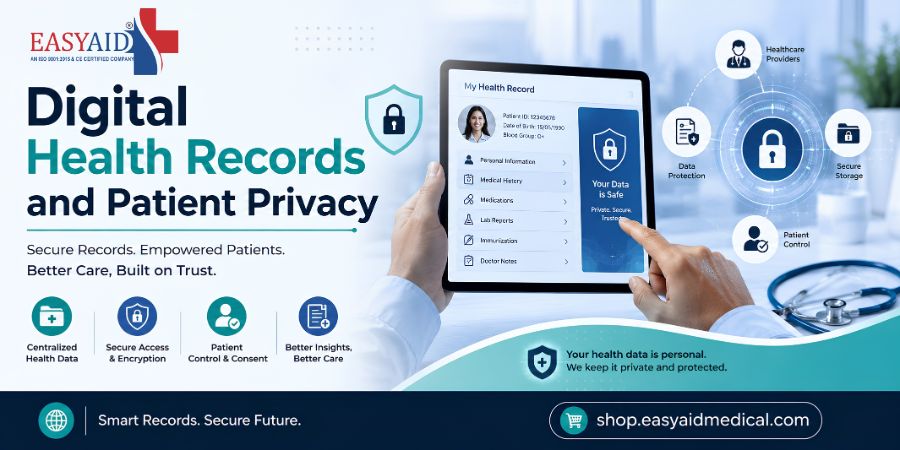
Digital Health Records and Patient Privacy: What Patients Should Know
Healthcare is becoming increasingly digital.
Medical histories that were once stored in paper files can now be recorded, updated, accessed, and shared through electronic systems. Test results, prescriptions, diagnoses, vaccination records, appointment details, and other health information can be available to authorized healthcare professionals when needed.
These systems are commonly referred to as digital health records.
The shift from paper-based records to digital systems can make healthcare information easier to access and coordinate. A doctor may be able to review relevant information without waiting for a physical file. Different healthcare services may also be able to exchange information when systems are designed to work together.
But there is another side to this convenience.
Health information is highly sensitive. If it is accessed by the wrong person, shared without proper authority, stored insecurely, or used for purposes that patients do not understand, it can create serious privacy and security concerns.
That is why patient data privacy in healthcare is not simply an IT issue. It is also a matter of patient rights, trust, governance, security, and responsible healthcare delivery.
The World Health Organization (WHO) emphasizes that digital health systems should be developed with principles such as privacy, security, confidentiality, transparency, and interoperability.
So, how do digital health records work, what makes them useful, and what should patients know about protecting their information?
What are digital health records?
Digital health records are electronic versions of health-related information that can be collected, stored, managed, and accessed through digital systems.
Depending on the healthcare organization and system, a record may contain information such as:
- Patient identification details
- Medical history
- Diagnoses
- Prescriptions
- Laboratory results
- Imaging reports
- Vaccination records
- Allergies
- Treatment information
- Doctor or hospital notes
- Appointment information
The exact information stored depends on the healthcare provider and the purpose of the system.
Digital records can exist within a particular healthcare facility or be connected to wider health information systems.
A key objective is to make relevant information available to authorized people when it is needed for patient care.
Why are digital health records important?
One of the biggest advantages of digital records is easier access to information.
Imagine visiting a new doctor after moving to another city. If your relevant medical history can be securely transferred or accessed through an appropriate system, the new healthcare professional may have more information to work with instead of relying entirely on paper documents or the patient’s memory.
Digital records can also help reduce some problems associated with paper files, such as physical loss, difficult storage, or delays in locating information.
When systems are properly designed, digital records can support:
- Better coordination between healthcare providers
- Faster access to relevant information
- More organised patient histories
- Easier tracking of test results
- More consistent documentation
- Better continuity of care
WHO’s work on digital health highlights the importance of systems that can exchange accurate information while maintaining appropriate privacy and security safeguards.
However, these benefits depend heavily on how the system is designed and governed.
Simply making health records digital does not automatically make healthcare better.
Why Patient Data Privacy Matters in Healthcare
Medical information is different from many other types of personal information.
A health record can reveal highly private details about a person’s physical or mental health, medications, treatments, family history, or other sensitive circumstances.
If such information is exposed without appropriate safeguards, the consequences can go beyond inconvenience.
Unauthorised disclosure could potentially lead to:
- Loss of privacy
- Fraud or identity-related risks
- Discrimination
- Stigma
- Personal distress
- Loss of trust in healthcare providers
WHO’s data principles recognise the importance of privacy and human rights when handling personal data, with particular attention to sensitive medical information and vulnerable groups.
For healthcare organisations, protecting patient information is therefore part of responsible care.
How are Digital Health Records Protected?
There is no single security measure that can protect a digital health record.
Effective protection generally requires multiple layers of technical, organisational, and procedural safeguards.
1. Access Controls
Not every employee in a healthcare organisation needs access to every patient’s information.
Access controls can restrict information based on a person’s role and responsibilities.
For example, a healthcare professional involved in a patient’s treatment may need access to relevant clinical information, while another employee may only need access to administrative details.
The principle is simple:
People should only have access to the information they are authorised and required to use.
Good access management also includes removing or changing permissions when an employee changes roles or leaves an organization.
2. Authentication
Healthcare systems should verify the identity of people attempting to access patient information.
This can involve measures such as:
- Strong passwords
- Multi-factor authentication
- Role-based accounts
- Secure login systems
- Session controls
The specific controls vary by organization and system.
Authentication is important because even a well-designed database can become vulnerable if unauthorised people can easily obtain legitimate users’ login credentials.
3. Encryption and Secure Data Transfer
Encryption helps protect information by converting it into a form that is difficult for unauthorized people to read.
It can be relevant both when information is stored and when it is transmitted between systems.
For example, when patient information moves between authorized systems, appropriate security measures can help reduce the risk of interception or unauthorized access.
Healthcare organizations should use security measures appropriate to the sensitivity and risks associated with the information they manage.
WHO guidance emphasizes the need for strong safeguards around the confidentiality, integrity, availability, and security of health information.
4. Audit Logs and Monitoring
A secure health information system should not only control access. It should also provide ways to monitor activity.
Audit logs can help organizations determine:
- Who accessed information
- When information was accessed
- What actions were taken
- Whether unusual activity occurred
Monitoring can help identify potential security incidents and support investigations when something goes wrong.
It also creates accountability.
If users know that access is recorded and monitored, there is an additional reason to follow appropriate data-handling procedures.
5. Secure Data Disposal
Protecting health information does not end when a record is no longer actively used.
Healthcare organisations need appropriate procedures for retaining, archiving, and disposing of information.
The exact retention period depends on the type of information, applicable laws, regulations, professional requirements, and the healthcare organisation’s policies.
When information is no longer required and can legally be disposed of, it should be destroyed or deleted using appropriate methods.
Patient Consent and Control Over Health Information
Privacy is not only about technical security.
Patients should also have appropriate information about how their health data is collected and used.
Depending on the purpose and applicable law, patients may need to provide consent for certain types of data processing or sharing.
However, consent requirements are not identical for every healthcare situation.
For example, health information may be processed as part of providing healthcare or meeting legal and public health obligations, even where separate consent is not the legal basis for every processing activity.
This is why healthcare organisations should clearly explain:
- What information they collect
- Why it is collected
- How it is used
- Who may receive it
- How it is protected
- How long it may be retained
- What rights patients have under applicable law
WHO’s data principles emphasise transparency and appropriate protection of personal data, while recognising that the legal basis for processing can vary depending on the purpose.
Data Sharing Between Healthcare Providers
Healthcare often involves more than one professional or organisation.
A patient may see a general physician, specialist, diagnostic centre, hospital, pharmacy, or other healthcare provider.
Sharing relevant information can help support continuity of care.
For example, a doctor may need access to a recent test result before making a treatment decision.
But information sharing should not mean unrestricted access.
Healthcare systems need appropriate rules governing:
- Who can access information
- What information can be shared
- Why it can be shared
- How it is transmitted
- How access is recorded
- What safeguards apply
WHO’s digital health guidance highlights interoperability as an important part of digital health systems, while also stressing privacy, security, and confidentiality.
Interoperability: Making Different Systems Work Together
One challenge with digital health records is that healthcare organisations may use different software systems.
If those systems cannot exchange information effectively, patients may still need to carry reports from one provider to another.
Interoperability aims to make different systems capable of exchanging and using information appropriately.
However, interoperability should not mean that all information becomes freely accessible across every system.
A well-designed system needs to balance the following:
Accessibility + interoperability + privacy + security
WHO’s SMART Guidelines initiative promotes standards-based, interoperable digital systems that can exchange accurate information while supporting appropriate data governance and quality.
Common Privacy Risks With Digital Health Records
Digital systems offer many advantages, but they also introduce risks.
Unauthorised Access
Someone may gain access to a system without permission, either through stolen credentials, weak security, insider misuse, or other methods.
Cyberattacks
Healthcare organizations can be targets for cyberattacks because medical information can be valuable to criminals.
Ransomware and other attacks can affect the availability and confidentiality of health information.
WHO has highlighted cybersecurity and privacy risks as important considerations for modern digital health information systems.
Accidental Disclosure
Privacy problems do not always involve deliberate attacks.
Information could potentially be sent to the wrong person, displayed to an unauthorised user, or handled incorrectly.
Excessive Data Collection
Collecting more information than necessary can increase privacy risks.
Healthcare organizations should have a clear purpose for the information they collect and appropriate policies for how it is used.
Third-Party Access
Digital healthcare may involve external technology providers, cloud services, applications, or other organisations.
Healthcare providers need appropriate controls and agreements to ensure that third parties handling patient information meet applicable privacy and security requirements.
Digital Health Records and Compliance
Compliance is an important part of managing digital health information.
However, there is no single global privacy law that applies identically to every healthcare organization.
Requirements can vary depending on:
- Country
- State or region
- Type of healthcare provider
- Nature of the information
- Purpose of data processing
- Whether information crosses borders
- Applicable healthcare and privacy regulations
Healthcare organizations should therefore identify the laws and regulatory requirements applicable to their location and activities.
Compliance should not be treated as a one-time checklist.
Organizations need ongoing processes for
- Data governance
- Access management
- Security monitoring
- Staff training
- Incident response
- Privacy assessments
- Vendor management
- Data retention
- Secure disposal
- Policy updates
WHO’s work on health information governance similarly emphasizes that effective governance requires clear decision-making structures, accountability, transparency, and appropriate implementation mechanisms.
What Should Healthcare Organizations Do?
A practical privacy and security program should begin with understanding what information the organization holds and how that information moves through its systems.
Healthcare organizations should consider the following:
Know the Data
Identify what patient information is collected, where it is stored, and how it is used.
Limit Access
Give users only the access required for their legitimate responsibilities.
Train Staff
Employees should understand privacy policies, security practices, phishing risks, password security, and appropriate handling of patient information.
Monitor Systems
Use logging and monitoring to identify unusual or unauthorised activity.
Prepare for Breaches
Organizations should have an incident response process for identifying, containing, investigating, and reporting data breaches where required.
Review Third Parties
Technology providers and other vendors that handle patient information should be assessed according to applicable requirements and organisational risk.
Keep Policies Updated
Privacy and cybersecurity requirements can change. Policies and procedures should be reviewed regularly rather than written once and forgotten.
WHO’s recent work on cybersecurity and privacy maturity for digital health information systems includes areas such as governance, data management, transmission security, data disposal, monitoring, and user behaviour.
What Can Patients Do to Protect Their Health Information?
Patients also have a role in protecting their digital health information.
Simple steps include:
- Use strong, unique passwords for healthcare accounts.
- Enable multi-factor authentication when available.
- Avoid sharing healthcare account passwords.
- Be cautious with suspicious emails or messages asking for health information.
- Use trusted healthcare applications and websites.
- Check privacy settings on health-related apps.
- Avoid accessing sensitive health accounts on unsecured public devices.
- Ask healthcare providers how your information is collected and used.
- Keep your contact and account information updated.
- Report suspicious access or activity to the relevant healthcare provider.
Patients should also be careful about entering sensitive health information into unfamiliar apps or online services simply because they appear convenient.
Before using a health application, it is worth checking who operates it, what information it collects, why it collects it, and what happens to the information afterwards.
The Future of Digital Health Records
Digital health records are likely to become increasingly connected with other healthcare technologies.
They may interact with:
- Telemedicine platforms
- Wearable devices
- Remote monitoring systems
- Diagnostic systems
- Health applications
- Clinical decision-support tools
- Artificial intelligence systems
This could make health information more useful across different stages of care.
But greater connectivity also means greater responsibility.
The more systems that collect, exchange, and process health information, the more important strong governance, security, privacy, and accountability become.
WHO’s recent work on health data governance notes that strong governance is essential for trusted digital health systems and becomes particularly important as health data is used for interoperability, data sharing, analytics, and AI.
Conclusion
Digital health records can make healthcare information easier to organise, access, and share. They can support continuity of care and help healthcare professionals work with more complete patient information.
But convenience should never come at the expense of privacy.
Patient data privacy in healthcare requires more than passwords and encryption. It involves appropriate access controls, secure systems, transparency, governance, staff training, monitoring, responsible data sharing, and compliance with applicable laws.
For patients, the key is to understand how their information is being used and to take sensible steps to protect their accounts and personal data.
For healthcare organizations, privacy should be built into the entire lifecycle of health information, from collection and storage to sharing, retention, and secure disposal.
Digital healthcare works best when patients can benefit from connected information without losing control over the privacy and security of their sensitive health data.
Frequently Asked Questions
1. What are digital health records?
Digital health records are electronic records containing a person’s health-related information. Depending on the healthcare system, they may include medical history, diagnoses, prescriptions, test results, allergies, vaccination information, and treatment records.
2. Why is patient data privacy important in healthcare?
Patient data privacy is important because health records contain highly sensitive personal information. Unauthorised access or disclosure can result in privacy violations, loss of trust, discrimination, fraud-related risks, or other harm.
3. How are digital health records protected?
Healthcare organisations can use measures such as access controls, authentication, encryption, audit logs, monitoring, staff training, secure data handling, incident response procedures, and appropriate data retention and disposal practices.
4. Can healthcare providers share digital health records?
Healthcare providers may share relevant health information when there is an appropriate legal or authorised basis to do so. The exact rules depend on the purpose, country, applicable privacy laws, healthcare regulations, and the organisations involved.
5. What can patients do to protect their digital health information?
Patients can use strong passwords, enable multi-factor authentication, avoid sharing account credentials, use trusted healthcare platforms, review privacy settings, and ask providers how their health information is collected, used, stored, and shared.
Authority References
World Health Organization (WHO): Digital Health Governance
WHO Digital Health and Governance
WHO Data Principles
WHO Data Principles
WHO: Cybersecurity and Privacy for Digital Health Information Systems
WHO Cybersecurity and Privacy Guidance