








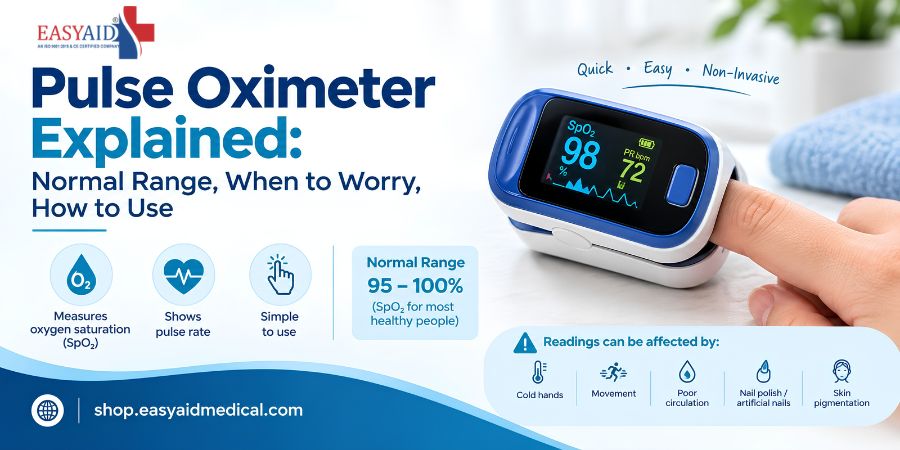
Pulse Oximeter Explained: Normal Range, When to Worry, How to Use
A pulse oximeter is a small device that can give you two useful readings within seconds: blood oxygen saturation (SpO₂) and pulse rate. It is commonly used at home, in hospitals and during routine health monitoring.
Because the device is simple to use, many families keep a pulse oximeter in their home healthcare kit. However, seeing a number on the screen does not always tell the whole story. The reading can change because of how the device is placed, cold fingers, movement, poor circulation or even the condition of the device.
That is why it helps to understand what a pulse oximeter measures, what is generally considered a normal range, and when a reading deserves medical attention.
This guide explains the basics in simple terms, including how to use a pulse oximeter at home, how to get a better reading, and what to do if the number looks lower than expected.
What Is a Pulse Oximeter?
A pulse oximeter is a small, non-invasive medical device that usually clips onto a fingertip. It uses light to estimate the percentage of haemoglobin carrying oxygen in the blood.
The result is displayed as SpO₂, usually as a percentage. Many pulse oximeters also show your pulse rate in beats per minute.
For example, the screen may show:
SpO₂: 98%
Pulse Rate: 76 bpm
The SpO₂ number is the oxygen saturation reading, while the second number represents the pulse rate.
Pulse oximeters are useful for monitoring oxygen saturation, but they should not be treated as a stand-alone diagnostic tool. A healthcare professional may consider the reading together with symptoms, medical history and other examination findings.
What Is the Pulse Oximeter Normal Range?
For many healthy people at sea level, an SpO₂ reading is generally around 95% to 100%.
However, there is no single number that is correct for every person in every situation.
A person’s usual reading can vary depending on their health, altitude, and other factors. People with certain respiratory or cardiac conditions may also have an individual target range given by their healthcare professional.
So, instead of focusing on one isolated number, it is often more useful to understand your usual readings and pay attention to a significant or persistent change.
A Simple SpO₂ Guide
| SpO₂ Reading | What It Generally Means |
|---|---|
| 95–100% | Generally considered a normal range for many healthy people |
| 90–94% | Lower than expected for many people; repeat the reading correctly and contact a healthcare professional if it remains low or you have symptoms |
| Below 90% | A potentially serious low reading that needs prompt medical assessment, particularly if it is persistent or accompanied by symptoms |
These ranges are intended as general information, not as a diagnosis.
If your doctor has given you a personal oxygen target, follow that guidance instead of relying on a general range found online.
Why Can a Pulse Oximeter Reading Be Low?
A lower-than-usual reading does not automatically mean that something serious is happening.
Sometimes the problem is the measurement itself.
Several factors can affect a pulse oximeter reading:
Cold Fingers
Cold hands can reduce blood flow to the fingertip. This may make it difficult for the device to detect a strong pulse signal.
Warm your hands naturally and allow them to return to a comfortable temperature before taking another reading.
Movement
Moving your finger or hand while the device is measuring can interfere with the reading.
Keep your hand still and relaxed for a more stable result.
Nail Polish or Artificial Nails
Dark nail polish, artificial nails or other coverings can sometimes interfere with the light used by the sensor.
If you are getting an unexpected reading, try another suitable finger or remove the covering if appropriate.
Poor Circulation
Reduced blood flow to the finger can make the reading less reliable.
If the number keeps changing or the device struggles to detect a pulse, check the position of the device and try again after resting.
Incorrect Placement
The sensor needs to sit correctly on the finger.
A loose, poorly positioned or incorrectly placed device may produce an unstable reading.
Device Quality
Not every consumer pulse oximeter provides the same level of measurement performance.
When buying one for home use, look for a reputable medical device and follow the manufacturer’s instructions.
How to Use a Pulse Oximeter at Home
Knowing how to use a pulse oximeter at home is just as important as knowing the normal range.
Follow these simple steps.
1. Sit and Rest
Sit comfortably for a few minutes before taking the measurement.
Avoid checking immediately after exercise, climbing stairs or another activity if you are trying to measure your resting SpO₂.
2. Warm Your Hands
Your hand should be comfortably warm.
If your fingers feel very cold, warm them naturally before measuring.
3. Remove Anything That May Interfere
If possible, avoid using a finger with thick nail polish or an artificial nail when you are getting an unexpected reading.
4. Place the Oximeter Correctly
Open the clip and place it securely over the fingertip.
The sensor should sit comfortably rather than squeezing the finger excessively.
5. Keep Your Hand Still
Rest your hand on a stable surface.
Do not talk, shake your hand or move your finger unnecessarily while the reading is settling.
6. Wait for a Stable Reading
Do not immediately record the first number that appears.
Give the device a little time to settle. Look for a stable SpO₂ number and a pulse reading.
7. Record the Result When Needed
If your healthcare professional has asked you to monitor your oxygen level, keep a simple record.
You can note:
- Date and time
- SpO₂ reading
- Pulse rate
- Whether you were resting or active
- Any symptoms you were experiencing
A record can help your healthcare professional understand changes over time.
Which Finger Should You Use?
For a typical fingertip pulse oximeter, the index or middle finger is commonly used.
The most important thing is to place the device correctly and use a finger that gives a stable signal.
If one finger gives an unusual reading, you can check another suitable finger and compare the results.
Do not repeatedly switch fingers every few seconds just to find a higher number. Instead, focus on getting a properly positioned, stable reading.
When Should You Worry About a Pulse Oximeter Reading?
One unusual number should not automatically cause panic.
First, check whether you measured correctly.
Sit down, warm your hands, position the device properly and wait for the reading to stabilise.
However, a persistently low reading, a downward trend or a low reading combined with concerning symptoms should not be ignored.
Seek medical advice if your SpO₂ remains lower than your usual level, particularly if you are feeling unwell.
Symptoms That Need Attention
Do not rely only on the number displayed on the device.
Seek prompt medical attention if a low oxygen reading is accompanied by symptoms such as:
- Difficulty breathing
- Significant shortness of breath
- Chest pain or pressure
- Confusion or unusual drowsiness
- Bluish lips or face
- Sudden worsening of your condition
If symptoms are severe or rapidly getting worse, seek emergency medical care rather than repeatedly checking the oximeter at home.
What If Your SpO₂ Is 90–94%?
A reading between 90% and 94% is lower than the usual range for many healthy people.
The right response depends on the individual situation.
Start by checking the measurement again under better conditions. Make sure your hands are warm, you are resting, the device is positioned correctly and you are not moving.
If the reading remains lower than expected, contact your healthcare professional for advice, especially if you have symptoms or the number is falling.
People who already have a respiratory or cardiac condition may have a different target range. In that situation, follow the range given by your doctor rather than using a general internet guideline.
What If Your SpO₂ Is Below 90%?
A persistent SpO₂ reading below 90% can indicate a significant problem and should not be ignored.
Check the reading again promptly using correct technique. If it remains below 90%, seek urgent medical assessment, particularly if you have breathing difficulty, chest discomfort, confusion or other concerning symptoms.
Do not use a pulse oximeter reading alone to decide whether you need oxygen therapy or to change prescribed medicines.
Oxygen is a medical treatment and should be used according to professional medical advice.
Pulse Oximeter Mistakes to Avoid
A pulse oximeter is easy to operate, but a few common mistakes can affect the reading.
Checking Immediately After Exercise
Your pulse and breathing change during physical activity. If you want a resting measurement, sit quietly before checking.
Keeping Cold Hands
Cold fingers can make it difficult for the sensor to get a good signal.
Moving During Measurement
Movement can cause unstable or inconsistent numbers.
Checking Only Once
If a reading looks unusual, repeat the measurement correctly rather than immediately assuming the first number is accurate.
Focusing Only on SpO₂
A pulse oximeter is only one part of health monitoring.
Your symptoms and overall condition matter too.
Using Someone Else’s Target Range
A person with a chronic respiratory condition may have a different monitoring plan from a healthy person.
Always follow your healthcare professional’s individual instructions.
How to Choose a Pulse Oximeter for Home Use
If you are planning to buy a pulse oximeter, do not choose only by appearance or the lowest price.
Consider these features:
Easy-to-Read Display
A clear screen is particularly useful for older adults and caregivers.
Reliable Measurement
Choose a product from a reputable manufacturer and follow the manufacturer’s instructions for use.
Comfortable Finger Clip
The device should fit comfortably without excessive pressure.
Pulse Rate Display
Many home pulse oximeters display both SpO₂ and pulse rate, which can be useful for routine monitoring.
Battery and Power Features
Check the battery type, expected battery life and whether replacement batteries are easily available.
Warranty and Customer Support
A warranty and accessible product support can be useful if you experience problems with the device.
For home healthcare equipment, ease of use matters. A device that is simple to operate correctly is generally more useful than one with unnecessary features that make monitoring confusing.
Pulse Oximeter vs Other Home Monitoring Devices
A pulse oximeter measures oxygen saturation and pulse rate. It does not replace other health-monitoring devices.
For example:
- A digital BP monitor measures blood pressure and pulse.
- A glucometer measures blood glucose from a blood sample.
- A thermometer measures body temperature.
- A pulse oximeter measures estimated oxygen saturation and pulse rate.
If you are building a home healthcare kit, choose monitoring devices based on your family’s actual needs and any recommendations from your healthcare professional.
Also Read – Antiseptic vs Antibiotic Ointment: What to Use for Minor Cuts and Wounds
Should Every Home Have a Pulse Oximeter?
There is no universal rule that every household must own one.
However, a pulse oximeter can be useful for families who have been advised by a healthcare professional to monitor oxygen saturation at home or who care for someone with a condition where oxygen monitoring is part of their care plan.
The important point is knowing how to use it properly and understanding its limitations.
Owning the device is not a substitute for medical care.
Frequently Asked Questions
1. What is the normal pulse oximeter range?
For many healthy people at sea level, an SpO₂ reading of 95% to 100% is generally considered normal. Individual targets can differ, especially for people with certain medical conditions. Follow your healthcare professional’s advice if you have been given a personal target.
2. How do you use a pulse oximeter at home?
Sit and rest, keep your hand warm, place the device correctly on your fingertip, keep your hand still and wait for the reading to stabilise. If the result looks unusual, repeat the measurement using the correct technique.
3. Is 94% oxygen saturation normal?
A reading of 94% is below the usual range for many healthy people. It does not automatically mean that you have a medical problem. Repeat the reading correctly and contact a healthcare professional if it remains low, is falling or is accompanied by symptoms.
4. Is an SpO₂ below 90% dangerous?
A persistent reading below 90% can be a serious warning sign and needs prompt medical assessment, especially when accompanied by breathing difficulty or other concerning symptoms. Do not rely on the oximeter alone to determine the cause.
5. Can a pulse oximeter diagnose a health condition?
No. A pulse oximeter provides an estimate of oxygen saturation and pulse rate. It cannot diagnose the cause of an abnormal reading. Healthcare professionals may use the reading along with symptoms, medical history and other assessments.
Final Takeaway
A pulse oximeter can be a useful tool for home health monitoring when used correctly.
For many healthy people, 95% to 100% is a typical SpO₂ range. Still, one reading should not be viewed in isolation. Measurement technique, hand temperature, movement, circulation and individual health conditions can affect the result.
If a reading is unexpectedly low, check the measurement again carefully. If it remains low, continues to fall or occurs with symptoms such as breathing difficulty, chest pain or confusion, seek medical advice promptly.
Most importantly, use a pulse oximeter to monitor, not to self-diagnose.
Need a Pulse Oximeter for Home Monitoring?
Choose a reliable pulse oximeter that is simple to use and suitable for your home healthcare needs.
Medical Disclaimer: This article is intended for general educational purposes only. It does not provide a medical diagnosis or replace advice from a qualified healthcare professional. If you have concerning symptoms or an unexpectedly low oxygen reading, seek appropriate medical care.