








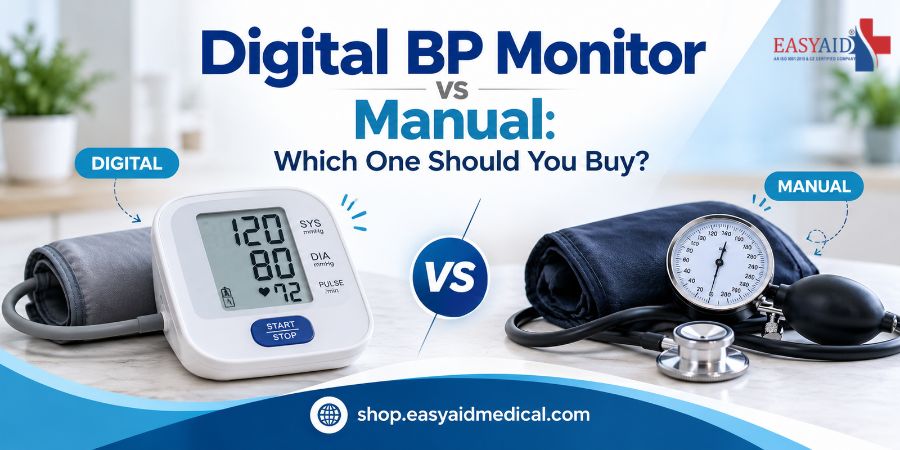
Digital BP Monitor vs Manual: Which One Should You Buy?
Checking blood pressure at home has become much easier with modern monitoring devices. A Digital BP Monitor can give a reading with the press of a button, while a manual blood pressure monitor requires a cuff, a stethoscope and someone who knows how to measure blood pressure correctly.
That difference matters when you’re choosing a device for your home.
So, when comparing a digital vs manual blood pressure monitor, which one should you buy?
For most people looking for a convenient home-monitoring option, a clinically validated digital upper-arm monitor is usually easier to use. Manual devices still have an important place in trained clinical settings.
The key, however, is not simply choosing digital over manual. Accuracy, validation, correct cuff size and proper measurement technique matter just as much.
WHO recommends clinically validated automated blood pressure devices and highlights the importance of accurate BP measurement for identifying and managing hypertension.
This guide explains the differences between digital and manual BP monitors, their advantages and limitations, and what to check before buying one in India.
What Is a Blood Pressure Monitor?
A blood pressure monitor measures the pressure of blood against the walls of your arteries.
The result normally includes two numbers:
- Systolic blood pressure: the pressure when the heart contracts.
- Diastolic blood pressure: the pressure when the heart relaxes between beats.
The monitor may also display your pulse rate.
High blood pressure often has no obvious symptoms. Regular measurement is therefore important for people who need BP monitoring. WHO notes that measuring blood pressure is the main way to detect hypertension.
A BP monitor can support home monitoring, but it does not replace a doctor’s assessment.
Also Read—Glucometer Buying Guide: How to Choose and Use a Blood Sugar Monitor at Home
Digital vs Manual Blood Pressure Monitor: What’s the Difference?
The biggest difference is how each device measures and displays the result.
Digital BP Monitor
A digital monitor uses an electronic sensor to detect changes in pressure and automatically calculates the reading.
The screen then displays the result.
You usually need to:
- Put the cuff on your arm.
- Sit correctly.
- Press the start button.
- Remain still and quiet.
- Read the result from the screen.
Manual BP Monitor
A manual monitor generally uses an inflatable cuff, a pressure gauge and a stethoscope.
The user or healthcare professional inflates the cuff and listens for blood-flow sounds while releasing the pressure.
The person taking the reading needs appropriate training and technique.
MoHFW’s hypertension guidance recognises both digital oscillometric devices and conventional sphygmomanometers, while stressing standardised measurement procedures and validated equipment.
Digital BP Monitor: Advantages
Digital monitors have become popular for home use for good reason.
Easy to Use
You don’t need to listen for Korotkoff sounds or manually interpret the pressure gauge.
Press the button and the device does the calculation.
That makes digital monitors practical for people who live alone or need regular home monitoring.
Easier for Older Adults
A large digital display can make readings easier to see.
Some models also have simple controls and memory functions.
These features can help caregivers track readings for older family members.
Less Training Required
A manual monitor requires someone who understands the measurement process.
Digital devices reduce that burden.
WHO’s India Hypertension Control Initiative materials describe digital devices as simpler to use than manual methods and note that validated digital instruments can provide reliable measurements when used correctly.
Useful for Home Monitoring
A digital monitor can be kept at home and used according to the schedule recommended by a healthcare professional.
The device can also store previous readings, depending on the model.
That makes it easier to review BP trends during a medical appointment.
Digital BP Monitor: Limitations
Digital does not automatically mean accurate.
The biggest mistake is buying an unvalidated device simply because it has many features.
WHO specifically warns about the accuracy of automated devices that have not undergone appropriate validation.
Other limitations can include:
- Incorrect cuff size
- Poor positioning
- Movement during measurement
- Talking during the reading
- Low batteries
- Device damage
- Incorrect use
- Irregular heart rhythms affecting some devices
Therefore, choosing a validated device matters.
Manual BP Monitor: Advantages
Manual monitors still have important uses.
Useful in Clinical Settings
Trained healthcare professionals can use manual sphygmomanometers effectively.
They can listen to the blood-flow sounds and interpret the reading directly.
No Electronic Display
A manual monitor does not depend on a digital screen.
It also does not require batteries for the pressure measurement itself.
Useful for Trained Professionals
Healthcare workers who have received appropriate training can use manual equipment as part of standard BP measurement.
MoHFW guidance includes auscultatory measurement using a sphygmomanometer and describes the technique required for accurate measurement.
Manual BP Monitor: Limitations
Manual measurement requires skill.
The person taking the reading must:
- Position the patient correctly
- Select the correct cuff
- Place the cuff correctly
- Inflate the cuff appropriately
- Listen carefully with a stethoscope
- Identify the relevant sounds
- Read the gauge correctly
Small errors can affect the result.
For that reason, a manual monitor may not be the most practical option for an untrained person who wants to check BP independently at home.
Digital vs Manual BP Monitor: Comparison
| Feature | Digital BP Monitor | Manual BP Monitor |
|---|---|---|
| Ease of use | Easy | Requires training |
| Best suited for | Home monitoring | Trained users/clinical settings |
| Stethoscope required | No | Yes |
| Manual reading required | No | Yes |
| Battery required | Usually | Usually not for gauge |
| Digital display | Yes | No |
| Memory function | Available in many models | Usually no |
| Training needed | Minimal | Higher |
| Portability | Usually convenient | Convenient but needs stethoscope |
| Home use | Very practical | Better with trained user |
| Accuracy | Reliable when validated and used correctly | Reliable when properly used |
| Cuff size | Important | Important |
The table gives a general comparison. Product specifications vary between manufacturers.
Which Is More Accurate: Digital or Manual?
This is one of the most common questions.
The answer isn’t simply “manual.”
A validated digital monitor can provide reliable measurements when used correctly.
WHO states that automated devices can offer consistent accuracy when they have been appropriately validated. The organisation also stresses the need to avoid non-validated devices because inaccurate readings can lead to incorrect clinical decisions.
Manual measurement can also be accurate when a trained person uses the correct equipment and technique.
So the better question is:
Is the device validated, and is it being used correctly?
That matters more than whether the display is digital or the gauge is manual.
What Is the Best BP Monitor for Home Use?
For most people who want to monitor blood pressure at home, a validated upper-arm digital BP monitor is a practical choice.
WHO-linked home BP guidance recommends arm devices and stresses correct cuff sizing.
When choosing one, look for:
- Upper-arm cuff
- Correct cuff size for the user
- Clinical validation
- Clear display
- Simple controls
- Memory function if useful
- Warranty
- After-sales support
- Easily available replacement accessories
Don’t choose a device only because it has Bluetooth or a smartphone app.
Those features can be helpful, but measurement quality comes first.
Why Cuff Size Matters
You can have an excellent BP monitor and still get a poor reading if the cuff doesn’t fit correctly.
A cuff that is too small or too large can affect the measurement.
Before buying, measure the user’s upper-arm circumference and compare it with the manufacturer’s cuff-size range.
MoHFW guidance specifically recommends using an appropriate cuff size and describes the relationship between cuff dimensions and arm circumference.
For families where several people use the same device, check whether the supplied cuff fits everyone.
Some models offer different cuff sizes.
How to Measure Blood Pressure at Home Correctly
The device is only part of the process.
Your position also matters.
Before Measuring
Sit quietly for several minutes.
Avoid talking during the measurement.
Make sure your back is supported.
Keep both feet comfortably supported and avoid crossing your legs.
Rest your arm on a surface so the cuff sits at the appropriate level.
MoHFW guidance recommends a relaxed seated position and several minutes of rest before measuring BP.
During the Reading
Place the cuff on the bare upper arm according to the manufacturer’s instructions.
Keep the tube positioned correctly.
Stay still.
Don’t talk.
Press the start button if you’re using a digital monitor.
Wait for the result.
Take More Than One Reading When Advised
One reading may not provide the complete picture.
MoHFW guidance recommends taking at least two readings during a visit, with an interval between them, and taking an additional reading when the results differ substantially.
For home monitoring, follow the measurement schedule recommended by your healthcare professional.
Common BP Monitoring Mistakes
Even a validated monitor can give misleading results when used incorrectly.
Measuring Immediately After Exercise
Physical activity can temporarily affect blood pressure.
Rest before measuring.
Talking During the Test
Conversation can affect the reading.
Stay quiet until the measurement finishes.
Crossing Your Legs
Keep your feet comfortably supported.
Using a Cuff Over Thick Clothing
Place the cuff according to the manufacturer’s instructions, usually on the bare upper arm.
Using the Wrong Cuff
Check the arm circumference before purchasing.
Taking Readings While Standing
For routine home measurement, use the recommended seated position unless your healthcare professional has instructed you differently.
Checking BP Only When You Feel Unwell
High blood pressure often has no obvious symptoms.
If you have been advised to monitor BP regularly, follow that schedule instead of waiting for symptoms.
Digital BP Monitor Buying Guide
If you’re ready to purchase a digital BP monitor, use this checklist.
1. Choose an Upper-Arm Model
For routine home monitoring, an upper-arm model is generally preferred over wrist devices.
WHO-linked guidance recommends arm devices because they are generally more reliable for home monitoring when used correctly.
2. Check Clinical Validation
Look for evidence that the specific model has undergone appropriate validation.
Don’t assume every digital BP monitor on the market has the same accuracy.
3. Check the Cuff Size
Make sure the supplied cuff fits the person who will use it.
4. Choose an Easy-to-Read Display
Large numbers can help older adults and people with vision difficulties.
5. Look for Memory Storage
A memory function can save previous readings.
This feature is useful when tracking BP over several days.
6. Check Warranty and Support
Choose a supplier that provides clear product information and after-sales support.
WHO’s home BP guidance also recommends checking warranty and service support before purchasing a monitor.
7. Consider Multiple-User Features
Some monitors allow separate user profiles.
This can be useful when more than one family member needs regular monitoring.
Digital BP Monitor for People With Diabetes
Blood pressure monitoring can also matter for people managing diabetes.
Diabetes and hypertension can occur together, and WHO identifies diabetes and chronic kidney disease among conditions associated with cardiovascular risk and hypertension.
That makes reliable home monitoring particularly useful when a healthcare professional has recommended regular BP checks.
However, don’t use a BP reading to make changes to diabetes medication or blood-pressure medication on your own.
Use the readings as information to discuss with your healthcare team.
What About Wrist BP Monitors?
Wrist monitors are compact and convenient.
However, they require careful positioning and can be more sensitive to technique.
For routine home monitoring, WHO-linked guidance recommends upper-arm devices.
If you need a wrist monitor because an upper-arm cuff is unsuitable, discuss the choice with your healthcare professional and follow the manufacturer’s positioning instructions closely.
How to Maintain a Digital BP Monitor
A BP monitor needs basic care.
Keep the device:
- Clean
- Dry
- Away from excessive heat
- Protected from drops
- Stored according to the manufacturer’s instructions
Check the cuff and tubing regularly.
Look for cracks, leaks or other damage.
Replace batteries when needed.
WHO’s India Hypertension Control Initiative materials also recommend regular checking and calibration of BP equipment according to manufacturer instructions.
When Should You Contact a Doctor?
Home BP monitoring provides useful information, but don’t interpret every number in isolation.
Contact your healthcare professional if:
- Your readings repeatedly fall outside the range discussed with you.
- You notice a new pattern of unusually high or low readings.
- You have symptoms along with an unusual BP reading.
- Your monitor repeatedly gives unexpected results.
- You are unsure how to interpret your readings.
Very high blood pressure with serious symptoms requires urgent medical attention.
WHO notes that very high BP, particularly around 180/120 mmHg or higher, can occur with symptoms such as chest pain, difficulty breathing, confusion, vision changes or severe headache. In such circumstances, seek immediate medical care.
Digital vs Manual: Which One Should You Buy?
For most people buying a BP monitor for home use, the choice is fairly straightforward.
Choose Digital If:
- You want to monitor BP at home.
- You are not trained to use a stethoscope.
- You want a simple one-button operation.
- You want stored readings.
- An older adult or caregiver will use the device.
- You want an upper-arm monitor that is easy to operate.
Choose Manual If:
- You are trained to measure BP manually.
- You work in a clinical environment.
- You need a traditional auscultatory method.
- You already know how to use a sphygmomanometer correctly.
For a typical home user, a clinically validated upper-arm digital monitor is usually the more convenient option.
Quick Buying Checklist
Before placing your order, check:
☐ Upper-arm design
☐ Clinically validated model
☐ Correct cuff size
☐ Easy-to-read display
☐ Simple controls
☐ Memory function if needed
☐ Warranty
☐ After-sales support
☐ Replacement accessories available
☐ Clear user instructions
Don’t let a long feature list distract you from the basics.
A reliable reading and correct technique matter most.
FAQs
1. Is a digital BP monitor better than a manual one?
For most people monitoring blood pressure at home, a clinically validated digital upper-arm monitor is easier to use. Manual monitors can also provide accurate readings when trained users follow the correct technique.
2. Are digital BP monitors accurate?
A validated digital BP monitor can provide reliable readings when the correct cuff size and measurement technique are used. However, not every digital device on the market has been validated, so check the specific model before buying.
3. Which BP monitor is best for home use?
An upper-arm digital monitor with clinical validation, the correct cuff size, a clear display and simple operation is a practical choice for most home users.
4. Is a wrist BP monitor as good as an upper-arm monitor?
Wrist monitors can be convenient, but they require careful positioning. For routine home monitoring, upper-arm devices are generally preferred in WHO-linked guidance.
5. How often should I check my blood pressure at home?
There is no single schedule for everyone. Your healthcare professional may recommend a specific monitoring routine based on your health and treatment. Follow that plan rather than checking randomly or changing medication based on individual readings.
Final Thoughts
Choosing between a digital and manual BP monitor doesn’t have to be complicated.
A manual monitor can work very well in trained hands. For most people at home, however, a clinically validated upper-arm digital BP monitor offers a simpler way to take regular readings.
Before buying, focus on the things that actually affect measurement quality: validation, cuff size, correct positioning, ease of use and reliable support.
Features such as Bluetooth and smartphone connectivity can be useful extras. They should come after accuracy and suitability.
If you are looking for a reliable digital BP monitor for home use, explore EasyAid Medical’s blood pressure monitoring range and choose a device that fits your monitoring needs.
Medical Disclaimer: This article is intended for general health education and awareness. It does not replace professional diagnosis, treatment or individual medical advice. Always follow your healthcare professional’s instructions and the manufacturer’s instructions for your BP monitor. Do not change prescribed medication based solely on home BP readings.