








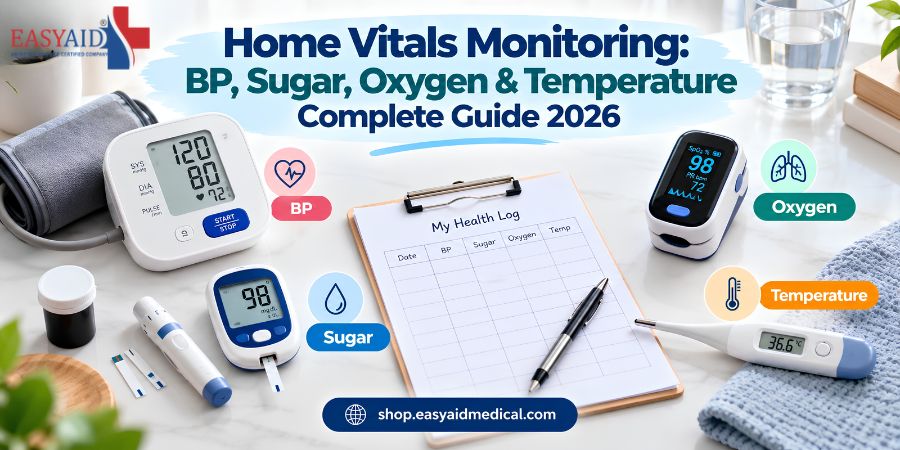
Home Vitals Monitoring: BP, Sugar, Oxygen & Temperature—Complete Guide 2026
You don’t need a hospital to keep track of basic health measurements.
Today, several home health monitoring devices can help families check blood pressure, blood glucose, oxygen saturation and body temperature at home.
These measurements can be useful for people managing a chronic condition. They can also help caregivers keep a simple record between medical appointments.
However, home monitoring has limits. A device gives you a reading. It does not provide a complete medical diagnosis.
That difference matters.
This home vitals monitoring guide India explains which devices are commonly used at home, how to use them correctly, what to record and when a reading should prompt you to contact a healthcare professional.
Medical note: Home monitoring supports healthcare. It does not replace a doctor’s examination, diagnosis or treatment. Always follow the monitoring schedule and instructions given by your healthcare professional.
What Are Vital Signs?
Vital signs are basic measurements that provide information about the body’s current state.
For home monitoring, four measurements are especially common:
- Blood pressure
- Blood glucose
- Oxygen saturation
- Body temperature
Each measurement answers a different question.
A BP monitor measures blood pressure.
A glucometer measures blood glucose from a small blood sample.
A continuous glucose monitor, or CGM, tracks glucose through a sensor.
A pulse oximeter measures oxygen saturation and pulse rate.
A thermometer measures body temperature.
Together, these devices can give a household a useful health record.
They should still be used alongside symptoms, medical history and professional advice.
Why Home Vitals Monitoring Matters
Home monitoring can make health information easier to track.
For example, someone with hypertension may record blood pressure readings over time. A person managing diabetes may track glucose according to their healthcare plan. A caregiver may record temperature or oxygen saturation when a family member is unwell.
Regular records can also help during medical appointments.
Instead of saying, “My BP was high last week,” you can show the doctor a dated record.
That makes the conversation more specific.
WHO also recognises self-care interventions that use appropriate health devices and diagnostics, while making clear that self-care complements rather than replaces the health system.
1. Blood Pressure Monitoring at Home
A digital blood pressure monitor is one of the most useful home health monitoring devices for households managing hypertension.
The device usually displays:
- Systolic blood pressure
- Diastolic blood pressure
- Pulse rate
How to Measure Blood Pressure Correctly
Small changes in technique can affect the reading.
For a more consistent measurement:
- Sit quietly for about five minutes before checking.
- Keep your back supported.
- Keep both feet supported on the floor.
- Do not cross your legs.
- Rest your arm comfortably on a surface.
- Keep the cuff at the appropriate level.
- Avoid talking during the measurement.
- Use the correct cuff size.
- Take readings according to your healthcare professional’s instructions.
India’s MoHFW guidance specifically recommends a relaxed position, supported back and arm, five minutes of quiet rest, correct cuff size and avoidance of exercise, tea/coffee and tobacco shortly before measurement.
Upper-Arm vs Wrist BP Monitor
When choosing a home BP monitor, you may see both upper-arm and wrist models.
For routine home monitoring, an upper-arm device is generally the preferred option when the cuff fits correctly.
WHO-linked guidance on home blood pressure monitors also recommends arm devices and stresses correct cuff sizing.
What Should You Look for When Buying a BP Monitor?
Check:
- Appropriate cuff size
- Clear digital display
- Easy operation
- Memory function, if useful
- Manufacturer information
- Warranty and after-sales support
- Appropriate validation or certification for the market
Don’t choose a monitor only because it is inexpensive.
Accuracy matters more than extra features.
2. Blood Glucose Monitoring at Home
Blood glucose monitoring is particularly relevant for people managing diabetes.
A traditional glucometer uses a small blood sample and a test strip to provide a glucose reading.
The result can help a person follow the monitoring plan provided by their healthcare professional.
What Does a Glucometer Need?
A typical blood glucose monitoring setup may include:
- Glucometer
- Test strips
- Lancing device
- Lancets
- Alcohol swabs or other appropriate supplies, where advised
- A record-keeping method
Always follow the instructions supplied with the meter and test strips.
The strips must also be stored correctly. Heat, moisture and improper storage can affect product performance.
How Often Should You Check Blood Sugar?
There is no single schedule that works for everyone.
The frequency depends on factors such as:
- Type of diabetes
- Medication
- Insulin use
- Diet and activity
- Age
- Pregnancy, where applicable
- Individual medical advice
WHO’s diabetes guidance recommends self-monitoring of blood glucose for people with type 1 and type 2 diabetes using insulin based on individual clinical need.
Therefore, don’t copy another person’s testing schedule.
Follow your own healthcare plan.
3. Continuous Glucose Monitoring and CGM Devices
Continuous glucose monitoring, or CGM, has changed the way many people track glucose.
Instead of taking a finger-stick reading every time, a CGM uses a sensor placed on the body to continuously measure glucose in interstitial fluid.
Depending on the system, readings can be viewed through a receiver, reader or smartphone application.
CGM can provide information about glucose patterns throughout the day.
It can also show trends rather than giving only individual readings.
Is CGM the Same as a Glucometer?
No.
A glucometer generally provides a point-in-time blood glucose reading.
A CGM provides ongoing glucose measurements through its sensor.
Both have different uses.
Your healthcare professional can help determine which monitoring method fits your situation.
Why Is CGM Getting Attention in India?
Interest in CGM is growing alongside wider adoption of digital health tools.
One 2026 industry estimate puts India’s CGM-device market growth at around 14.8% CAGR from 2026 to 2035. Other market research estimates produce different growth rates, so the exact figure depends on the market definition and forecast period.
For consumers, the more important question is simple:
Does this monitoring method fit your medical needs and monitoring plan?
Technology should support care, not replace professional guidance.
4. Pulse Oximeter for Oxygen Monitoring
A pulse oximeter is a small device that usually clips onto a finger.
It can display:
- Oxygen saturation, or SpO₂
- Pulse rate
WHO describes pulse oximetry as a non-invasive method for measuring oxygen saturation and recognises pulse oximeters as useful medical devices for detecting and monitoring low blood oxygen.
How to Use a Pulse Oximeter
For a better reading:
- Sit still.
- Keep your hand relaxed.
- Place the device correctly on the finger.
- Wait for the reading to settle.
- Look at the displayed oxygen saturation and pulse.
- Consider the person’s symptoms along with the number.
Cold fingers, movement, poor circulation and other factors can affect readings.
Therefore, don’t panic over one unexpected number.
Repeat the measurement correctly and consider the person’s symptoms.
When Should Oxygen Readings Concern You?
There is no single number that should be interpreted without context.
A person’s usual oxygen level, medical condition and symptoms all matter.
If someone has significant breathing difficulty, chest pain, confusion, blue or grey lips, severe weakness or other serious symptoms, seek urgent medical care rather than relying on a pulse oximeter.
WHO also notes that home pulse-oximetry is useful only when users know how to interpret readings and have access to healthcare providers who can advise on the next step.
EasyAid Medical: Add an internal link here to the Pulse Oximeter category.
5. Temperature Monitoring at Home
A digital thermometer is one of the simplest home monitoring devices.
It can help you check body temperature when someone feels unwell.
Depending on the thermometer, measurement may be taken orally, under the arm, in the ear or through another approved method.
Always follow the manufacturer’s instructions.
Why Consistency Matters
Different measurement methods can produce different results.
Therefore, when tracking temperature over time, try to use the same device and method whenever practical.
Record:
- Date
- Time
- Temperature
- Measurement method
- Relevant symptoms
This gives you a clearer picture than checking the temperature randomly.
How to Build a Home Vitals Monitoring Kit
A basic monitoring kit does not need to contain every medical device available.
Start with the equipment that matches your family’s needs.
Basic Home Monitoring Checklist
☐ Digital blood pressure monitor
☐ Digital thermometer
☐ Pulse oximeter
☐ Glucometer, if required
☐ Compatible glucose test strips
☐ Lancets
☐ Alcohol swabs or other recommended supplies
☐ Notebook or digital health log
☐ Batteries or charging accessories
For families managing diabetes, the glucose-monitoring section may be more important.
For someone with hypertension, a reliable BP monitor may be the priority.
For a person with a condition that affects breathing, a pulse oximeter may be useful when recommended by their healthcare provider.
How to Choose Home Health Monitoring Devices
Buying a health device online can feel confusing.
Look beyond the product photo.
1. Check the Intended Use
Make sure the device is designed for the measurement you need.
A general wellness gadget is not automatically equivalent to a medical device.
2. Check the Size and Fit
This matters especially for BP monitors.
A cuff that is too large or too small can affect measurements.
3. Look at the Display
The numbers should be easy to read.
This is particularly important for older adults.
4. Check Consumables
Some devices require ongoing purchases.
For example, glucometers need compatible test strips and lancets.
CGM systems require replacement sensors according to the manufacturer’s schedule.
Calculate the ongoing cost before buying.
5. Check Support and Warranty
A health device should come with clear instructions.
Good after-sales support can also make a difference.
6. Don’t Pay Only for Extra Features
Bluetooth, app connectivity and cloud storage can be useful.
However, they should not be the main reason for choosing a device.
Start with accuracy, suitability and ease of use.
How to Keep a Home Vitals Record
A simple record can be more useful than a drawer full of readings.
Create columns for:
| Date | Time | BP | Blood Sugar | SpO₂ | Temperature | Notes |
|---|
You don’t have to record every measurement in the same way.
Instead, follow the schedule recommended for the individual.
Write down anything that may help explain the reading.
For example:
- Before or after a meal
- Before or after medication, when relevant
- After exercise
- Fever or other symptoms
- Unusual stress
- Poor sleep
- Feeling dizzy or weak
This context can help your healthcare professional understand the pattern.
Common Home Monitoring Mistakes
Home devices are useful, but technique matters.
Taking BP While Talking
Talking can affect the measurement.
Stay quiet and relaxed.
Using the Wrong BP Cuff
An incorrect cuff size can affect the reading.
Check the manufacturer’s sizing information.
Testing Blood Sugar Without Following the Care Plan
More testing is not automatically better.
Follow the schedule recommended by your healthcare professional.
Ignoring Symptoms Because the Number Looks Normal
A device reading is only one part of the picture.
If someone feels seriously unwell, don’t dismiss the symptoms because a home device shows a reassuring number.
Panicking Over One Abnormal Reading
One reading may not tell the whole story.
Repeat the measurement correctly when appropriate and consider the person’s symptoms and usual readings.
Sharing Personal Monitoring Supplies
Do not share lancets or other single-use items between people.
Follow the device manufacturer’s safety instructions.
When Should You Contact a Doctor?
Home monitoring works best when you know what to do with the information.
Contact your healthcare professional when:
- Your readings repeatedly differ from your usual range.
- Your doctor has asked you to report certain readings.
- You notice a new or worsening symptom.
- Your glucose readings are repeatedly outside the range discussed with your healthcare team.
- Your blood pressure readings are repeatedly unusual.
- Oxygen readings remain concerning, particularly when symptoms are present.
- You are unsure how to interpret a result.
For emergencies, don’t wait for another home reading.
Seek urgent medical help for severe breathing difficulty, chest pain, fainting, confusion, severe weakness, uncontrolled bleeding or other serious symptoms.
Home Monitoring for Older Adults
Older adults may benefit from a simple setup.
Keep the devices in one accessible location.
Choose displays with large, clear numbers.
Label the devices if several family members use different equipment.
A caregiver can also maintain a written or digital record.
Most importantly, make sure the person knows what each number means and when to ask for help.
Home Monitoring for Chronic Disease Management
People with chronic conditions may use monitoring devices as part of a longer-term care plan.
For example:
Hypertension: BP readings can help track blood pressure between appointments.
Diabetes: Glucose monitoring can help follow an individual diabetes-management plan.
Respiratory conditions: Pulse oximetry may be used when recommended by a healthcare professional.
Fever or infection: Temperature readings can help document changes over time.
The device does not manage the condition by itself.
It provides information that can support clinical decisions.
How to Store Your Monitoring Devices
Good storage helps protect your equipment.
Keep devices:
- Clean and dry
- Away from excessive heat
- Away from direct sunlight
- Away from moisture
- In their original packaging where practical
- With accessories stored together
For glucose meters, follow the manufacturer’s instructions for strips, lancets and storage conditions.
Replace batteries or consumables as required.
Check your devices periodically instead of waiting until you need them during an illness.
Quick Home Vitals Monitoring Checklist
Before you buy or use a monitoring device, ask:
☐ What health measurement do I need to track?
☐ Has my healthcare professional recommended monitoring?
☐ Is the device suitable for home use?
☐ Is the BP cuff the correct size?
☐ Are replacement strips or sensors easily available?
☐ Can I read the display easily?
☐ Do I understand how to use the device?
☐ Do I know what to do if the reading is unusual?
☐ Can I keep a simple record?
☐ Is the device covered by a suitable warranty or support service?
This approach keeps home monitoring practical instead of turning it into a collection of unused gadgets.
FAQs
1. What are the most useful home health monitoring devices?
Common devices include digital BP monitors, glucometers, CGM systems, pulse oximeters and digital thermometers. The right combination depends on the person’s health needs and advice from their healthcare professional.
2. Is home blood pressure monitoring accurate?
A good-quality device can provide useful home readings when you use it correctly. Correct cuff size, proper positioning and a consistent measurement routine matter. Home readings should still be discussed with a healthcare professional when managing hypertension.
3. What is the difference between a glucometer and a CGM?
A glucometer usually gives a blood glucose reading from a small blood sample at a particular time. A CGM uses a sensor to monitor glucose continuously or at frequent intervals, depending on the system. Your healthcare professional can help determine which method suits your needs.
4. Can I use a pulse oximeter to diagnose a health problem?
No. A pulse oximeter provides an oxygen saturation reading and pulse rate. It does not diagnose the cause of an abnormal reading. Symptoms and medical assessment remain important.
5. How often should I check my vitals at home?
There is no universal schedule. The frequency depends on the measurement, health condition, treatment plan and advice from your healthcare professional. Follow the schedule recommended for you rather than copying someone else’s routine.
Final Thoughts
Home monitoring can make everyday healthcare more organised.
A reliable BP monitor can help track blood pressure. A glucometer or CGM can support diabetes monitoring. A pulse oximeter can provide oxygen-saturation information when appropriate. A thermometer can help document temperature changes.
The key is to use these devices correctly.
Don’t chase numbers without context.
Instead, keep consistent records, follow your healthcare professional’s instructions and pay attention to symptoms.
For families in India, building a simple home monitoring kit can also make it easier to keep important health information ready for medical appointments.
EasyAid Medical offers essential healthcare equipment for home monitoring and everyday care.
Medical Disclaimer: This article is for general health education and awareness. Home monitoring devices do not replace professional diagnosis or treatment. Always follow the instructions supplied with your device and the monitoring plan provided by your healthcare professional. If you experience severe or emergency symptoms, seek urgent medical care.