








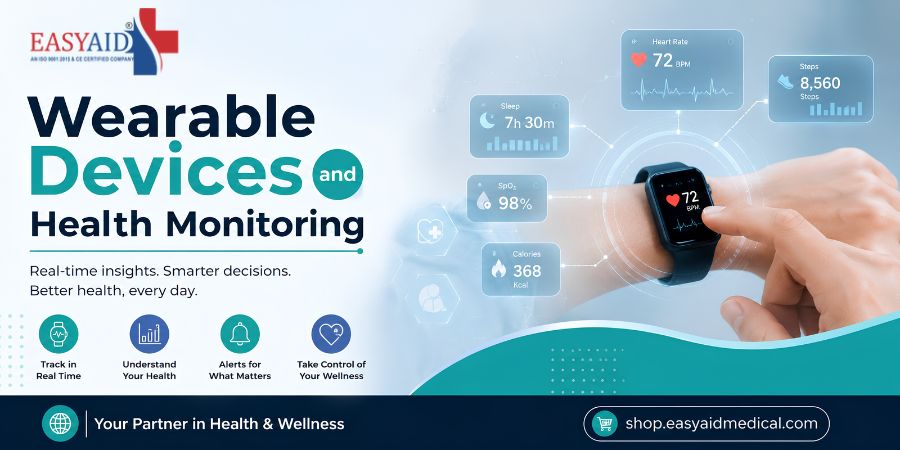
Wearable Devices and Health Monitoring
Health monitoring used to be something most people did during a doctor’s appointment or a routine medical check-up. Today, smartphones, smartwatches, fitness bands, and other connected devices allow people to track certain health-related measurements throughout the day.
These products are commonly referred to as wearable health devices.
Depending on the device, a wearable may track steps, physical activity, heart rate, sleep patterns, calories, blood oxygen levels, or other measurements. Some advanced devices can also provide features such as electrocardiogram (ECG) recording or notifications about unusual heart-rate patterns.
This constant stream of information can help people understand their everyday habits. It can also give healthcare professionals additional information in some situations.
But there is an important distinction to remember: tracking a health measurement is not the same as diagnosing a medical condition.
Wearable devices have limitations. Their sensors may not always be accurate, measurements can vary between devices, and the information they provide needs to be interpreted in the right context.
So, what can wearable devices actually tell you, and where should you be careful?
Also Read – How AI is Changing Preventive Healthcare
What Are Wearable Health Devices?
Wearable health devices are electronic products designed to be worn on the body and collect information about activity, physiological measurements, or other aspects of health.
Common examples include:
- Smartwatches
- Fitness bands
- Activity trackers
- Smart rings
- Heart-rate monitors
- Certain medical monitoring devices
- Connected patches and sensors
The capabilities differ considerably from one device to another.
A basic fitness band may mainly count steps and estimate activity. A more advanced smartwatch may measure heart rate, record an ECG, monitor sleep, or provide other health-related features.
The important point is that not every wearable measures the same things, and not every measurement has the same level of clinical accuracy.
What Health Information Can Wearables Track?
One reason wearable health devices have become popular is that they can collect information over long periods rather than during a single appointment.
1. Physical Activity
Most fitness trackers can record some form of physical activity.
Depending on the device, this may include the following:
- Steps
- Walking distance
- Active minutes
- Exercise sessions
- Estimated calories burned
- Activity intensity
This information can make everyday activity easier to understand.
For example, someone who believes they are physically active throughout the day may discover that most of their day is actually spent sitting.
The value is often in identifying patterns rather than focusing on one day’s number.
2. Heart Rate
Many wearable devices use optical sensors to estimate heart rate.
Heart-rate information can be useful for understanding how the body responds to activity and rest. Users may be able to see their heart rate during exercise, resting periods, or throughout the day.
Some devices can also alert users when their heart rate appears unusually high or low under certain conditions.
However, a wearable heart-rate reading should not automatically be treated as a medical diagnosis.
Factors such as movement, device placement, skin contact, exercise intensity, and the technology used by the device can affect readings.
If a person experiences symptoms such as chest pain, fainting, severe shortness of breath, or significant palpitations, they should seek appropriate medical care rather than relying on a wearable notification.
3. Sleep
Sleep tracking is another popular feature.
Wearables may estimate:
- Total sleep duration
- Time spent awake
- Sleep timing
- Sleep stages
- Sleep consistency
Looking at sleep patterns over time can help people recognize habits.
For example, a person may notice that their sleep duration decreases consistently on workdays or that their bedtime changes significantly from one day to another.
But sleep tracking has limitations.
A consumer wearable generally does not measure sleep in the same way as a clinical sleep study. It may estimate sleep stages using movement, heart rate, and other signals rather than directly measuring brain activity.
Therefore, wearable sleep data should be viewed as an estimate rather than a definitive assessment of sleep quality or a diagnosis of a sleep disorder.
Understanding Fitness Trackers’ Health Data
The amount of information produced by modern wearables can be impressive.
However, more data does not automatically mean better health decisions.
Fitness trackers’ health data is most useful when viewed as a collection of trends rather than isolated numbers.
For example, one unusually low activity day may not mean much. But consistently declining activity over several weeks may be worth paying attention to.
Similarly, a single unusual heart-rate reading may have several possible explanations. Repeated measurements, symptoms, medical history, and professional assessment may be needed to understand what is actually happening.
This is why context matters.
A wearable can tell you what it measured. It usually cannot explain the complete medical reason behind that measurement.
How Wearables Can Support Preventive Health
Wearables can play a useful role in everyday preventive healthcare.
Encouraging Physical Activity
Seeing daily activity levels can encourage people to move more.
A simple step goal or activity reminder may help break up long periods of sitting and create greater awareness of daily movement.
The device itself does not make someone healthier. The potential benefit comes from how the information influences behavior.
Identifying Personal Patterns
Wearables can create a record of changes over time.
Users may notice patterns involving:
- Activity
- Sleep
- Resting heart rate
- Exercise
- Recovery
- Daily routines
These observations can help people make practical lifestyle adjustments.
Supporting Conversations With Healthcare Professionals
Health data from a wearable can sometimes provide useful background information during a healthcare consultation.
For example, a person may be able to show several weeks of activity or heart-rate trends rather than relying entirely on memory.
However, the healthcare professional still needs to determine whether the information is reliable and relevant.
Can Wearables Detect Health Problems?
Some wearable devices have features designed to detect or flag specific patterns.
For example, certain devices may analyze heart-rate data or ECG recordings and provide notifications about possible irregularities.
This can potentially encourage someone to seek professional evaluation.
But there is a major difference between detecting a pattern and diagnosing a condition.
A notification from a wearable does not necessarily mean that a person has a particular disease. Conversely, a device failing to provide an alert does not guarantee that everything is medically normal.
This distinction is particularly important because wearable devices are not designed to replace medical examinations.
If someone has persistent or concerning symptoms, professional medical evaluation remains important regardless of what their wearable reports.
The Accuracy Limitations of Wearable Devices
One of the biggest questions surrounding wearable health devices is accuracy.
The answer is not simply “accurate” or “inaccurate.”
Accuracy depends on:
- The type of measurement
- The device
- Sensor quality
- How the device is worn
- Movement
- Skin contact
- The individual’s characteristics
- The algorithm used to interpret sensor readings
- The conditions under which the measurement is taken
For example, a wearable may estimate heart rate reasonably well during certain activities but perform differently during intense movement.
Similarly, calorie expenditure is generally an estimate rather than a direct measurement.
Users should therefore avoid treating every number on a smartwatch or fitness tracker as an exact clinical measurement.
Wearable Data Is Not the Same as Medical Data
This is one of the most important limitations to understand.
A wearable device may collect health-related information, but that does not automatically make the information equivalent to data collected using clinical equipment.
Medical devices and diagnostic systems may undergo specific testing, validation, and regulatory processes depending on their intended use and jurisdiction.
Consumer wearables can be extremely useful for tracking trends and encouraging healthy behaviors, but users should understand what their particular device is actually designed to measure.
The National Institutes of Health (NIH) has supported research into wearable and sensor technologies for health and biomedical applications, including the use of digital measurements to better understand health and disease.
Can Wearables Replace Regular Health Check-Ups?
No.
Even the most advanced smartwatch cannot provide a complete picture of someone’s health.
Routine healthcare may involve:
- Medical history
- Physical examination
- Blood tests
- Imaging
- Blood pressure measurement
- Professional risk assessment
- Other diagnostic tests
A wearable generally covers only a small part of this picture.
Think of it as another source of information rather than a replacement for healthcare.
For example, knowing your daily steps can be useful, but it does not tell you your cholesterol level. Tracking sleep duration does not diagnose a sleep disorder. Monitoring heart rate does not provide a complete cardiovascular assessment.
Privacy and Security of Wearable Health Data
Health-related information is sensitive, and wearable devices can collect a surprisingly detailed picture of someone’s daily routine.
Depending on the product and its connected services, data may include information about
- Movement
- Exercise
- Sleep
- Heart rate
- Location
- Daily routines
Before buying or using a wearable, it is worth checking what information the device collects, where that information is stored, and how it is used.
Users should also review privacy settings and understand which apps or services have access to their data.
Convenience is valuable, but health data deserves careful handling.
How to Use Wearable Health Devices Responsibly
A few simple habits can make wearable data more useful.
Focus on Trends
Do not become overly concerned about every small change in a daily measurement. Look for patterns over time.
Understand What Your Device Measures
Read the manufacturer’s information about each health feature and understand whether a measurement is an estimate or a clinically validated measurement.
Do Not Self-Diagnose
Use wearable data as information, not as a substitute for professional medical advice.
Pay Attention to Symptoms
If you feel unwell, do not ignore symptoms simply because your wearable shows a normal reading.
Share Relevant Information With Your Doctor
If you have been tracking a particular measurement and think it may be relevant to your health, discuss it with your healthcare professional.
What Is the Future of Wearable Health Monitoring?
Wearable technology is likely to become more integrated with digital healthcare.
Future devices may offer more sophisticated sensors, better data analysis, improved connectivity, and more personalized health insights.
Research into wearable and digital health technologies is also expanding. NIH-supported research has explored how wearable sensors can collect physiological and behavioral information for health research and clinical applications.
But technological progress does not remove the need for caution.
Better sensors can still produce imperfect measurements. More data can still be misunderstood. And an algorithm can still make an incorrect interpretation.
The most useful future for wearable health devices is therefore not one where people stop seeing doctors. It is one where reliable information can help people understand their health better and help healthcare professionals make better-informed decisions.
Final Thoughts
Wearable health devices have made health monitoring more accessible than ever.
A smartwatch or fitness tracker can help users understand activity, sleep, heart rate, and other measurements. Over time, this information can reveal personal patterns and encourage healthier everyday habits.
However, wearable data has limits.
Measurements may be estimates. Sensors can be affected by how a device is worn and the conditions in which it is used. A notification is not necessarily a diagnosis, and a normal reading does not guarantee that there is no health problem.
The best approach is to use wearable technology as a health-monitoring aid, not a replacement for professional healthcare.
When combined with regular check-ups, appropriate medical testing, healthy habits, and professional guidance, wearable devices can become a practical tool for understanding and managing everyday health.
Frequently Asked Questions
1. What are wearable health devices?
Wearable health devices are electronic products worn on the body that collect health or activity-related information. Examples include smartwatches, fitness bands, smart rings, heart-rate monitors, and certain medical monitoring devices.
2. What health data can fitness trackers collect?
Depending on the device, fitness trackers can collect information such as steps, physical activity, heart rate, exercise duration, sleep patterns, and other measurements. Some advanced devices offer additional features such as ECG recording or blood oxygen estimation.
3. Are wearable health devices accurate?
Accuracy varies depending on the device, measurement, sensor technology, and circumstances. Wearable readings can be affected by movement, device placement, skin contact, and other factors. They should not automatically be treated as equivalent to clinical measurements.
4. Can a smartwatch diagnose a health condition?
Generally, consumer wearables should not be treated as diagnostic tools. Some devices can identify or flag certain patterns that may require further evaluation, but a healthcare professional must interpret those findings in the appropriate medical context.
5. Should I share wearable health data with my doctor?
You can discuss relevant wearable data with your doctor, particularly if you have noticed a consistent pattern or change. Your healthcare professional can help determine whether the information is reliable and clinically relevant.
Authority Source
National Institutes of Health (NIH) – NIH research and resources on wearable sensors, digital health technologies, and health monitoring can be used as an authoritative reference for this article.