








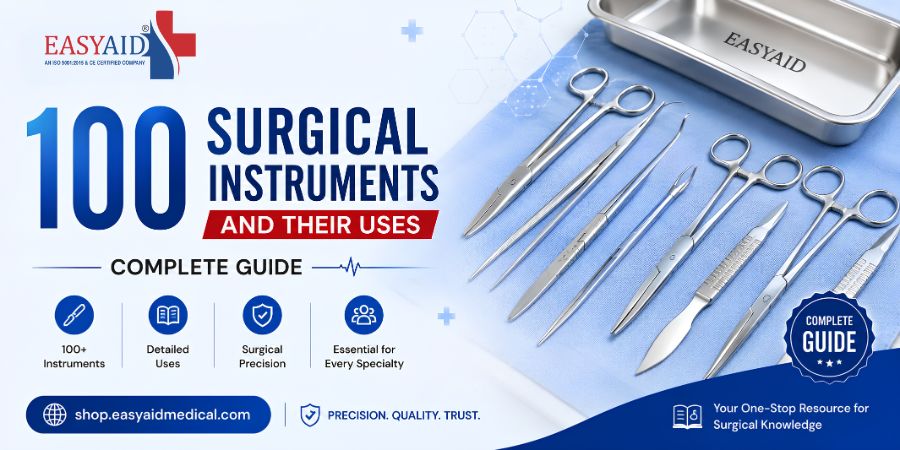
100 Surgical Instruments and Their Uses | Complete Guide
Every successful surgery depends on the right tool in the right hand at the right moment. Surgical instruments are the precise, purpose-built devices that let surgeons cut, hold, clamp, stitch, and view tissue safely during an operation. From a simple scalpel that makes the first incision to delicate microsurgical forceps used in eye surgery, each instrument has one clear job. If you are a medical student, a nursing or operating-room technician, or simply curious about how surgery works, knowing these tools by name and function is the first step toward confidence in the operating room.
This complete guide explains the 100 most common surgical instruments in simple, easy-to-read language. We have grouped them into ten clear categories based on what they do, so you can learn faster and remember longer. For each tool you will find a short introduction, its main uses, and key features. After the list, you will learn about the materials these instruments are made from, how to spot high-quality tools, how they are sterilised, and how to care for them so they last for years. Let’s begin with the basics.
What Are Surgical Instruments?
Surgical instruments are specially designed tools that surgeons and their teams use to perform medical procedures. They are used for cutting, dissecting, holding, grasping, occluding, clamping, retracting, suturing, and dilating tissue. Each tool is engineered for a specific task, which helps the surgeon work with accuracy and reduces the risk of injury to the patient.
Most modern instruments are made from high-grade stainless steel, but some are made from titanium, tungsten carbide, or even disposable plastic. Surgical instruments are generally grouped into cutting/dissecting, grasping/holding, retracting, clamping, suturing, and suction/aspiration categories, and each category supports a specific function during surgery. Understanding these groups makes it much easier to learn the individual tools.
Why Surgical Instruments Are Important in Modern Surgery
Surgical instruments are the foundation of safe, precise surgery. Forceps allow surgeons to hold delicate tissues, while clamps provide a firm grip to prevent bleeding, and each instrument is designed for specific tasks to ensure the surgeon can perform the procedure with precision. Without the correct tool, even a skilled surgeon cannot work safely or efficiently.
The right instruments also reduce tissue damage, control bleeding, and improve healing. Cutting tools must be sharp and precise to ensure that the surrounding tissues remain intact and uninjured. Quality matters too, because well-made tools resist corrosion, hold their edge, and stay reliable through hundreds of sterilisation cycles. In short, good instruments protect patients and support better surgical outcomes.
4. The 100 Most Common Surgical Instruments and Their Uses
Cutting and Dissecting Instruments
These tools cut skin, tissue, and sometimes bone, or separate tissue along its natural planes. Scissors are straight or curved instruments used for heavy-duty cutting or delicate dissection. They must stay sharp to protect the tissue around them.
1. Scalpel Handle #3 The scalpel handle #3 is the most common knife handle in surgery. It holds smaller blades such as #10, #11, and #15. Surgeons use it for fine, precise incisions in skin and soft tissue. Its balanced design gives the surgeon excellent control.
2. Scalpel Handle #4 The scalpel handle #4 is a larger, heavier handle that holds bigger blades like the #20 and #22. It is used for deeper or longer incisions where more force is needed. The sturdy grip makes it ideal for general and orthopaedic surgery.
3. Blade #10 The #10 blade has a curved cutting edge and is one of the most widely used surgical blades. It is used to make large skin incisions in general surgery. Its rounded belly allows smooth, sweeping cuts.
4. Blade #11 The #11 blade has a sharp, pointed triangular tip. It is used for stab incisions, draining abscesses, and opening blood vessels. The fine point allows very precise entry into tissue.
5. Blade #15 The #15 blade is small with a short curved edge. It is used for short, delicate, and precise incisions, such as in plastic surgery and paediatric procedures. Its small size gives the surgeon fine control.
6. Mayo Scissors Mayo scissors are heavy scissors with semi-blunt ends, often used to cut thick tissues or sutures, and are available either straight or curved. Straight Mayo scissors usually cut sutures, while curved ones cut dense tissue. They are a staple in almost every surgical tray.
7. Metzenbaum Scissors Metzenbaum scissors are lighter scissors used for cutting delicate tissue and for blunt dissection. They have long handles with short blades for control. Surgeons rely on them for fine tissue work.
8. Iris Scissors Iris scissors are used for precise cuts in delicate surgeries, like eye procedures, and their small size and sharpness are key for detailed work. They are very fine and sharp. They are common in ophthalmic and plastic surgery.
9. Tenotomy Scissors Tenotomy scissors are small, fine scissors with delicate, often curved blades. They are used to cut tendons and other delicate structures, especially in eye and hand surgery. Their pointed tips allow access to tight spaces.
10. Operating Scissors Operating scissors are general-purpose cutting tools available in straight or curved, blunt or sharp tip designs. They are used for cutting tissue, sutures, and surgical materials. Their versatility makes them a basic instrument in nearly every procedure.
Grasping and Holding Instruments
These tools grip tissue, vessels, and other objects so the surgeon can move or steady them. Grasping and holding instruments grip tissues, blood vessels, or other objects and provide a clear, unobscured view of the surgical field. They come in toothed and non-toothed versions for different tissues.
11. Adson Tissue Forceps: Adson’s forceps are known for their fine tips, perfect for delicate tissues, and are often used in neurosurgery and plastic surgery. They may be toothed or smooth. Their slim design gives a secure but gentle grip.
12. Dressing Forceps Dressing forceps are non-toothed forceps with serrated tips. They are used to handle dressings, pack wounds, and remove debris. Their smooth tips avoid damaging delicate skin.
13. DeBakey Forceps DeBakey forceps are non-toothed forceps used in a wide variety of procedures and can grasp tissues, such as bowels, without damaging them. They are a favourite in vascular and cardiac surgery. Their fine rows of ridges hold tissue gently but firmly.
14. Russian Tissue Forceps Russian tissue forceps have a distinctive round, star-shaped tip. They give a strong, wide grip on tissue without cutting into it. They are useful when a firm hold on bulky tissue is needed.
15. Brown-Adson Forceps Brown- Adson forceps have multiple small teeth at the tip for a secure grip. They are used to hold skin and delicate tissue during closure. The many teeth spread pressure and reduce tissue trauma.
16. Allis Tissue Forceps: Allis forceps are used by obstetricians for colporrhaphy, the anterior and posterior repair. They have small teeth that grip firmly. They are used to hold tough tissue that will be removed or stitched.
17. Babcock Forceps Babcock forceps are used for grasping intestines and tubular structures. They have smooth, rounded tips to avoid damage. Surgeons use them on delicate organs like the bowel and ureters.
18. Sponge Holding Forceps Sponge-holding forceps are long instruments with ringed tips and a locking ratchet. They hold gauze sponges to clean and prep the surgical site. They can also grasp tissue when needed.
19. Foerster Forceps Foerster forceps are a type of sponge-holding forceps with ring-shaped jaws. They are used to hold swabs, prep the skin, and grasp tissue. The locking handle keeps a steady grip.
20. Thumb Forceps Thumb forceps are frequently called tweezers or pinning forceps. They are held like a pencil and squeezed to grip tissue. They come in toothed and smooth varieties for different tasks.
Clamping and Hemostatic Instruments
These tools clamp blood vessels and tissue to control bleeding. Haemostatic forceps have a locking mechanism called a ‘ratchet’, and when they are used to control blood flow, they are known as ‘haemostats’ that compress blood vessels to hinder the flow of blood or fluids. Stopping bleeding keeps the surgical field clear.
21. Mosquito Hemostat: The mosquito hemostat is a small, fine clamp with a ratchet lock. It clamps tiny blood vessels to stop minor bleeding. Its delicate tips suit precise work in small spaces.
22. Kelly Hæmostat: Kelly clamps are larger-sized variations of hæmostatic instruments used for grasping larger tissues or vessels. They have transverse serrations on the lower half of the jaw. They are used to clamp medium-sized vessels.
23. Crile Haemostat: The Crile haemostat is similar to the Kelly but has serrations along the full length of the jaw. It clamps small- to medium-sized vessels and tissue. The full serration gives a more even grip.
24. Rochester-Pean Clamp: The Rochester-Pean clamp is a large, strong hemostat with fully serrated jaws. It is used to clamp large vessels and bundles of tissue. Its size makes it ideal for major surgery.
25. Rochester-Carmalt Clamp: The Rochester-Carmalt clamp has long jaws with criss-cross serrations and grooves at the tip. It clamps large tissue bundles and vascular pedicles. The pattern prevents tissue from slipping.
26. Kocher Clamp: The Kocher clamp is a heavy, toothed clamp with interlocking teeth at the tip. It grips tough, slippery tissue such as fascia. The teeth give a very secure hold.
27. Mixter Forceps: A right angle, also known as a mixter, is used to clamp vessels that are hard to reach and for suturing behind or around the vessel. Its right-angled tip reaches around structures. It is widely used in vascular and thoracic surgery.
28. Bulldog Clamp: The bulldog clamp is a small, spring-loaded clamp that gently closes off blood vessels. It is used in vascular and microvascular surgery. Its light pressure protects delicate vessel walls.
29. Satinsky Clamp: The Satinsky clamp is a large vascular clamp with a curved, tangential jaw. It partially clamps large vessels like the aorta while blood still flows. This allows the surgeon to work on part of a vessel safely.
30. Hemoclip Applicator: A hemoclip applier with hemoclips is used to clip vessels so that they remain occluded during surgery. It places small metal clips on vessels. This seals them quickly without stitching.
Retractors and Exposure Instruments
Retractors hold tissue or organs out of the way so the surgeon can see and reach the surgical site. Retractors come in two main types, hand-held and self-retaining; hand-held retractors require a surgical assistant to hold them, while self-retaining retractors remain positioned by themselves. Both improve visibility and access.
31. Army-Navy Retractor: The Army-Navy retractor is a handheld, double-ended retractor with flat blades at each end. It holds back shallow tissue and skin edges. It is one of the most common retractors in surgery.
32. Senn Retractor: The Senn retractor is a small double-ended tool with a flat blade on one end and small rake-like prongs on the other. It is used for shallow, delicate retraction in minor surgery. Its small size suits fine work.
33. Richardson Retractor: The Richardson retractor is a sturdy handheld retractor with a right-angled blade. It holds back deeper layers like muscle and the abdominal wall. The wide blade spreads pressure evenly.
34. Deaver Retractor: The Deaver retractor is a large, curved blade used to retract deep organs. It is common in abdominal and chest surgery. Its broad curve gently moves organs aside.
35. Langenbeck Retractor: Langenbeck retractors are one of the multiple types of retractors available in varying sizes and lengths. They have an L-shaped blade for holding back tissue edges. They are widely used in general surgery.
36. Weitlaner Retractor: The Weitlaner is a self-retaining retractor that holds incisions open. It has a ratchet to stay in place on its own. The pronged arms keep wound edges apart without an assistant.
37. Gelpi Retractor: The Gelpi is a self-retaining retractor that holds an incision open. It has two sharp, pointed tips that spread apart. It frees the surgeon’s hands during the procedure.
38. Volkmann Retractor: The Volkmann retractor is a handheld rake retractor with curved prongs. It holds back skin and soft tissue in shallow wounds. The prongs come in sharp or blunt versions.
39. Harrington Retractor: The Harrington retractor, also called a sweetheart retractor, has a large heart-shaped blade. It moves and holds large organs like the liver. Its broad surface protects delicate tissue.
40. Bookwalter Retractor: The Bookwalter retractor is a self-retaining system with a ring frame and multiple attachable blades. It holds large abdominal incisions open from many angles. It is widely used in major abdominal surgery.
Suturing Instruments
These tools help close wounds by holding needles and managing sutures. Needle holders firmly hold surgical needles while stitching wounds or tissues. Accurate suturing supports proper healing.
41. Mayo-Hegar Needle Holder: The Mayo-Hegar needle holder is a strong, ratcheted instrument with short, sturdy jaws. It grips suture needles firmly during stitching. It is a standard tool for most surgical closures.
42. Olsen-Hegar Needle Holder: The Olsen-Hegar needle holder combines a needle holder and scissors in one tool. It holds the needle and cuts the suture without switching instruments. This saves time during closure.
43. Crile-Wood Needle Holder: The Crile-Wood needle holder has narrower jaws than the Mayo-Hegar. It is used for finer needles and delicate suturing. Its slim design improves precision.
44. Webster Needle Holder: The Webster needle holder is a small, fine instrument used in plastic and delicate surgery. It holds very small needles for fine sutures. Its light build suits detailed work.
45. Castroviejo Needle Holder: The Castroviejo needle holder is a tiny spring-action tool used in microsurgery and eye surgery. It holds extremely fine needles. The spring grip allows precise, controlled movement.
46. Mathieu Needle Holder: The Mathieu needle holder has a curved, spring-loaded handle that locks when squeezed. It is used for fast suturing in tight spaces. The palm grip is comfortable and quick.
47. Needle Counter: The needle counter is a small foam-lined box or magnetic pad. It safely holds and counts used needles during surgery. It helps prevent sharps from being left in the patient.
48. Ligature Carrier: The ligature carrier is a slim, blunt instrument used to pass a suture or ligature around a vessel or structure. It reaches deep or hard-to-access areas. This helps tie off vessels safely.
49. Knot Pusher: The knot pusher is a long instrument that slides a knot down to a deep tissue site. It is often used in laparoscopic and deep surgery. It secures knots where fingers cannot reach.
50. Suture Scissors: Suture scissors are simple, sturdy scissors used to cut sutures. They usually have a blunt tip to avoid harming tissue. They are a basic part of every closing tray.
Suction and Aspiration Instruments
These tools remove blood, fluid, and debris to keep the surgical site clear. Suction tips remove excess blood or fluids to keep the surgical site clear. A clean field improves visibility and safety.
51. Yankauer Suction Tip: The Yankauer suction tip is a rigid, curved tube with a rounded head. It removes large amounts of fluid and blood from the surgical field. It is common in general and oral surgery.
52. Poole Suction Tube: The Poole suction tube is a straight tube with an outer perforated guard. It removes large volumes of fluid from body cavities like the abdomen. The guard stops tissue from blocking the tip.
53. Frazier Suction Tube: The Frazier suction tube is a fine, angled tube used in delicate surgery. It removes small amounts of fluid in neurosurgery and ear surgery. Its thin tip suits precise work.
54. Suction Cannula: A suction cannula is a hollow tube connected to a suction source. It draws fluid and debris from the surgical site. It comes in many sizes for different procedures.
55. Aspirating Syringe: The aspirating syringe is used to draw out fluid or inject medication. It lets the surgeon confirm placement before injecting. It is common in dental and minor procedures.
56. Suction Catheter: A suction catheter is a flexible tube used to clear fluids from airways or wounds. It is often used during and after surgery. Its soft tip reduces tissue trauma.
57. Thoracic Suction Device: The thoracic suction device removes fluid and air from the chest cavity. It helps re-expand the lungs after chest surgery. It is connected to a controlled drainage system.
58. Bone Marrow Aspiration Needle: This is a thick, strong needle used to draw bone marrow samples. It is used to diagnose blood disorders and cancers. The sturdy design penetrates dense bone.
59. Liposuction Cannula: The liposuction cannula is a long, thin tube with side openings. It removes fat during cosmetic and reconstructive surgery. It connects to a suction machine.
60. Surgical Evacuator: A surgical evacuator removes fluid, blood clots, or tissue fragments. It is often used in urology and bladder procedures. It keeps the surgical area clean and visible.
Dilating and Probing Instruments
These tools widen openings or explore body passages and wounds. They help the surgeon access narrow channels or trace the path of a wound. Many are smooth and blunt to avoid damage.
61. Uterine Dilator: The uterine dilator is a smooth, rod-like tool used to widen the cervix. It is used before procedures inside the uterus. It comes in a graduated set of increasing sizes.
62. Hegar Dilator: The Hegar dilator is a double-ended, curved metal rod used to dilate the cervix. Each end has a different diameter for gradual widening. It is common in gynaecological procedures.
63. Pratt Dilator: The Pratt dilator is a curved dilator with a tapered tip. It is used to widen the cervix gently and smoothly. Its design allows controlled dilation.
64. Urethral Dilator: The urethral dilator is a thin rod used to widen a narrowed urethra. It treats strictures that block urine flow. It comes in several sizes for progressive dilation.
65. Lacrimal Probe: The lacrimal probe is a fine, smooth probe used to explore and open tear ducts. It is used in eye surgery. Its delicate tip prevents injury to the duct.
66. Grooved Director: A grooved director is a surgical instrument used to guide cutting instruments along a safe path. It has a channel that directs the blade. This protects nearby tissue during incision.
67. Surgical Probe: A surgical probe is a slim, blunt instrument used to explore wounds and cavities. It helps trace the depth and direction of a wound. The blunt tip avoids creating new injuries.
68. Sinus Probe: The sinus probe is a fine, flexible probe used to explore sinus tracts or fistulas. It maps abnormal channels in tissue. This guides further treatment.
69. Fistula Probe: The fistula probe is a long, flexible tool used to explore the path of a fistula. It is common in anorectal surgery. It helps the surgeon plan the repair.
70. Sound Instrument: A surgical sound is a curved, blunt instrument used to explore or measure body passages. It is often used in urology to check the bladder or urethra. Its smooth surface reduces injury.
Specialized Surgical Instruments
This group includes bone tools and devices for special tasks. A bone curette is a common instrument used by neurosurgeons and orthopaedic surgeons, and other cutting or dissecting tools include bone cutters, snares, and blunt dissectors. They handle harder structures and unique jobs.
71. Curette: A curette is a spoon-shaped instrument with a sharp or blunt edge. It scrapes tissue or bone from a surface. It is used in orthopaedic, gynaecological, and dental work.
72. Bone Rongeur: The bone rongeur is a strong, plier-like tool with sharp, cupped jaws. It bites away small pieces of bone. It is common in orthopaedic and spinal surgery.
73. Osteotome: The osteotome is a chisel-like tool used to cut or shape bone. Unlike a chisel, it is bevelled on both sides. It is used in joint and reconstructive surgery.
74. Bone Chisel: The bone chisel has a single bevelled edge for cutting and shaping bone. It is struck with a mallet to remove or sculpt bone. It is widely used in orthopaedics.
75. Bone File: The bone file is a textured tool used to smooth rough bone edges. It removes sharp spurs after cutting. This protects surrounding soft tissue.
76. Gigli Saw: The Gigli saw is a flexible wire saw with handles at each end. It cuts through bone using a back-and-forth motion. It is used in amputations and skull surgery.
77. Dermatome: The dermatome is a specialised tool that cuts thin layers of skin. It is used to harvest skin grafts for burns and wounds. It produces even, controlled slices.
78. Speculum: Special surgical instruments such as speculums are designed to visualise internal structures that are not visible externally. A speculum holds open a body cavity for examination. Common types include vaginal, nasal, and ear specula.
79. Trocar: Trocars enable minimally invasive procedures, reducing incision size, recovery time, and surgical complications. A trocar is a sharp-pointed instrument used to create an entry point. It often comes with a cannula sleeve.
80. Cannula: A cannula is a hollow tube inserted into the body to deliver or drain fluid or to allow instruments to pass. It is often paired with a trocar. It comes in many sizes for different uses.
Laparoscopic Instruments
These long, thin tools are used in minimally invasive (“keyhole”) surgery. Laparoscopic instruments such as trocars and graspers enable minimally invasive procedures, reducing incision size, recovery time, and surgical complications. They work through small ports instead of large incisions.
81. Laparoscopic Grasper: The laparoscopic grasper is a long instrument with small jaws at the tip. It holds and moves tissue inside the body through a small port. It is controlled from outside the patient.
82. Laparoscopic Scissors: Laparoscopic scissors are long, slim scissors used to cut tissue during keyhole surgery. They reach deep inside through a port. Some connect to electrocautery for sealing.
83. Laparoscopic Needle Holder: This is a long needle holder used to stitch tissue during laparoscopic surgery. It grips needles firmly through a narrow port. It allows suturing without open access.
84. Veress Needle: The Veress needle is a spring-loaded needle used to safely inflate the abdomen with gas. The gas creates space to work. Its safety mechanism protects internal organs.
85. Trocar Sleeve: The trocar sleeve, or port, is a hollow tube that stays in the small incision. It lets instruments pass in and out easily. It keeps the entry point open during surgery.
86. Clip Applicator: The laparoscopic clip applicator places small clips on vessels or ducts. It seals structures without stitching. It is common in gallbladder removal.
87. Endoscopic Retractor: The endoscopic retractor holds tissue or organs aside during keyhole surgery. It improves the surgeon’s view through the camera. It works through a small port.
88. Suction Irrigation Device: This tool both flushes fluid in and suctions it out during laparoscopic surgery. It keeps the field clean and clear. It is essential for good visibility.
89. Endoscopic Forceps: Endoscopic forceps are long forceps used to grasp tissue or take biopsies inside the body. They pass through an endoscope or port. They allow tissue sampling without open surgery.
90. Laparoscopic Hook: The laparoscopic hook is an L-shaped tool often connected to electrocautery. It cuts and seals tissue at the same time. It is widely used for fine dissection.
Microsurgical and Specialty Instruments
These very fine tools are used for delicate work on small structures like nerves, vessels, and the eye. They demand extreme precision. Many are made for use under a microscope.
91. Micro Forceps: Microforceps are extremely fine, delicate forceps for handling tiny tissues. They are used in eye, nerve, and vascular surgery. Their fine tips allow precise grasping.
92. Micro Scissors: Micro scissors are tiny, sharp scissors used to cut very small structures. They are common in microsurgery and ophthalmic procedures. Their fine blades make precise cuts.
93. Vessel Dilator: The vessel dilator gently opens the end of a small blood vessel before joining it to another. It is used in microvascular surgery. This eases reconnection of vessels.
94. Castroviejo Forceps: Castroviejo forceps are fine, spring-action forceps used in eye surgery. They hold delicate tissue securely. The spring grip gives smooth, controlled handling.
95. Corneal Scissors: Corneal scissors are tiny curved scissors designed for the cornea of the eye. They make precise cuts during eye surgery. Their curve matches the shape of the eye.
96. Ophthalmic Speculum: The ophthalmic speculum, or eye speculum, holds the eyelids open during eye surgery. It keeps the eye exposed and steady. Its gentle design protects the eyelids.
97. Vascular Clamp: Vessel clips and bulldog clamps are delicate clamps used in surgery. The vascular clamp gently closes blood vessels without crushing them. It controls blood flow during vessel repair.
98. Nerve Hook: The nerve hook is a fine, hooked instrument used to gently lift and move nerves. It protects nerves during dissection. Its smooth tip avoids nerve injury.
99. Micro Needle Holder: The micro-needle holder grips extremely fine needles in microsurgery. It allows precise suturing of small vessels and nerves. The delicate jaws give fine control.
100. Bipolar Forceps: Bipolar forceps deliver an electrical current between their two tips to seal small vessels. They stop bleeding precisely without affecting nearby tissue. They are common in neurosurgery and microsurgery.
Surgical Instrument Materials Explained
Most surgical instruments are made from medical-grade stainless steel because it is strong, durable, and resists rust. As a sustainable, cost-effective option, medical-grade stainless steel is the superior choice, and while upfront costs are higher than other alloys such as aluminium, stainless steel has a longer useful life and won’t need to be replaced as frequently. Different grades of steel are chosen for different tools, depending on how much hardness or flexibility each one needs.
Two main criteria to consider when choosing surgical instruments are the quality of the steel and the manufacturing process itself. Some instruments also use titanium, which is lighter and non-magnetic, making it ideal for microsurgery. Cutting edges are sometimes reinforced with tungsten carbide for longer sharpness. Disposable plastic instruments are used for single-use, low-cost, or sterile-sensitive procedures.
How to Identify High-Quality Surgical Instruments
High-quality surgical instruments are built to last and perform reliably through repeated use. High-quality surgical tools are durable, corrosion-free, and resistant to physical and chemical changes. Look for smooth surfaces, well-aligned jaws, and a locking mechanism that closes evenly.
Quality also comes from careful manufacturing. Manufacturing quality instruments involves standards for various aspects of the process, including the basic requirements for quality steel and vigorous inspection for every step. Check that the tips meet correctly, the ratchet holds firmly, and there are no rough edges or pitting. A reliable instrument should feel balanced in the hand and operate smoothly without sticking.
How Surgical Instruments Are Sterilized
Sterilisation removes all germs from instruments to protect patients from infection. The sterilisation process encompasses various methods, including steam sterilisation, gas plasma sterilisation, and chemical sterilisation, each designed to eliminate pathogens and microorganisms effectively. The most common method is steam sterilisation in an autoclave.
An autoclave sterilises equipment by exposing items to high-pressure saturated steam, typically between 121 and 134°C, and this process effectively eliminates bacteria, viruses, fungi, and spores. For stainless steel tools, sterilise at 121°C to 134°C with a pressure of 15–30 psi for 20–30 minutes, depending on the cycle. Instruments with hinges should be opened or disassembled before autoclaving to allow steam penetration. For heat-sensitive instruments, liquid chemical sterilisation or hydrogen peroxide gas plasma may be used.
Common Surgical Instrument Care and Maintenance Tips
Good care keeps instruments safe, sharp, and long-lasting. Clean surgical instruments under warm running water, rinse thoroughly, then lubricate all instruments with surgical instrument lubricants and dry thoroughly to minimise condensation that can cause damage. Cleaning should happen soon after use, because dried blood and tissue are harder to remove and can damage the metal.
Here are key maintenance practices to follow:
- Clean promptly and thoroughly. If soiled material dries or is baked onto the instruments, it will interfere with microbial inactivation and can compromise the sterilisation process.
- Lubricate hinges. Use medical-grade lubricants, never oil-based ones, and store instruments in sterile, dry environments with dividers.
- Inspect before use. Inspect to ensure instruments are fully functional and free of bioburden before placing them in the autoclave.
- Avoid flash sterilisation when possible. Flash autoclaving will reduce the useful life of an instrument, particularly when it is constructed of various materials with different expansion rates.
- Cool gradually. Avoid immersing freshly sterilised instruments in cold water to speed up cooling.
Frequently Asked Questions (FAQs)
What are the most commonly used surgical instruments?
The most common surgical instruments are scalpels, scissors, forceps, hemostats, retractors, and needle holders. A scalpel makes precise incisions; forceps grasp tissues securely; retractors pull back tissue for visibility; and haemostats clamp blood vessels to control bleeding. These basic tools appear in almost every type of surgery.
How many surgical instruments are used in a typical operation?
The number varies widely depending on the procedure. A minor operation may use only a handful of tools, while a major surgery can require dozens or even over a hundred instruments arranged on the tray. The surgical team prepares the exact set needed for each specific procedure.
What is the difference between forceps and clamps?
Forceps are mainly used to grasp and hold tissue, while clamps lock onto vessels or tissue to control bleeding or hold structures in place. Haemostatic forceps have a ratchet locking mechanism, and when used to control blood flow, they are known as ‘haemostats’ that compress blood vessels. Many clamps are actually a locking type of forceps.
Why are surgical instruments made of stainless steel? Stainless steel is strong, resists corrosion, and withstands repeated sterilisation. Metals like stainless steel are highly resistant to high temperatures, pressure, and moisture, making them ideal for autoclaving and ensuring they retain their structural integrity through sterilisation. This makes them safe and durable for long-term use.
How are surgical instruments sterilised?
They are most often sterilised in an autoclave using high-pressure steam. Healthcare personnel clean, disinfect, and sterilise instruments to protect patients from infections and minimise risk to staff. Heat-sensitive tools may be sterilised with chemicals or hydrogen peroxide gas plasma instead.
What instruments are used for suturing?
Suturing uses needle holders, suture scissors, and tissue forceps. Needle holders firmly hold surgical needles while stitching wounds or tissues. Forceps steady the tissue while the needle holder passes the needle through.
What are laparoscopic surgical instruments?
Laparoscopic instruments are long, thin tools used in minimally invasive surgery. Laparoscopic instruments such as trocars and graspers enable minimally invasive procedures, reducing incision size, recovery time, and surgical complications. They work through small keyhole incisions with the help of a camera.
How long do surgical instruments last?
With proper care, high-quality stainless steel instruments can last for many years and hundreds of sterilisation cycles. Their lifespan depends on the quality of the steel, how they are cleaned, and how they are sterilised. Flash autoclaving can shorten an instrument’s useful life, so gentler routine cycles help preserve them.
What are the different categories of surgical instruments?
Surgical instruments are generally grouped into cutting/dissecting, grasping/holding, retracting, clamping, suturing, and suction/aspiration categories, and each category supports a specific function during surgery. Additional groups include dilating, probing, laparoscopic, and microsurgical instruments.
How do surgeons choose the right instrument for a procedure?
Surgeons choose instruments based on the type of tissue, the depth of the surgery, and the specific task. Each instrument is designed for specific tasks to ensure the surgeon can perform the procedure with precision. The right tool reduces tissue damage and improves the outcome.
Conclusion
Surgical instruments are far more than simple tools; they are precise extensions of a surgeon’s skill and judgment. By grouping them into clear categories like cutting, grasping, clamping, retracting, suturing, suction, dilating, specialized, laparoscopic, and microsurgical tools, you can learn all 100 instruments faster and understand exactly what each one does. Knowing these names and functions builds the confidence every medical student, technician, and curious learner needs in the operating room.
Just as important as knowing the tools is caring for them properly. High-quality stainless steel instruments, cleaned promptly, lubricated, inspected, and sterilised correctly, can serve safely for many years. When the right instrument is well-maintained and placed in skilled hands, it supports safer surgery and better patient outcomes, which is the ultimate goal of every operation.
References
Textbooks and Academic References
- Rothrock, Jane C. Alexander’s Care of the Patient in Surgery, 17th Edition. Elsevier, 2022. Comprehensive reference covering perioperative care, surgical instrumentation, instrument handling, and operating-room procedures.
- Phillips, Nancymarie. Berry & Kohn’s Operating Room Technique, 14th Edition. Elsevier, 2022.
- Wells, Maryann Papanier & Bradley, Darlene C. Surgical Instrumentation: An Interactive Approach, 4th Edition. Elsevier, 2021.
- Tighe, Shirley M. Instrumentation for the Operating Room: A Photographic Manual, 10th Edition. Elsevier.
- Fuller, Joanna Kotcher. Surgical Technology: Principles and Practice, 8th Edition. Elsevier.
- Goldman, Lee & Schafer, Andrew I. Goldman-Cecil Medicine. Elsevier.
- Townsend, Courtney M. et al. Sabiston Textbook of Surgery: The Biological Basis of Modern Surgical Practice. Elsevier.
Educational and Medical Resources
- MedlinePlus Surgery Overview, an educational resource from the U.S. National Library of Medicine covering surgical procedures, laparoscopic surgery, and operative principles.
- World Health Organization Decontamination and Reprocessing of Medical Devices for Health-Care Facilities, Official WHO guidance for sterilization, decontamination, instrument processing, and infection prevention.
- World Health Organization Medical Device Reprocessing Aide-Memoire, Reference for cleaning, disinfection, sterilization, and quality control of surgical instruments.
Surgical Instrument Classification References
- Wikipedia Surgical Instrument, Classification of surgical instruments including forceps, clamps, retractors, needle holders, scissors, dilators, probes, suction devices, and surgical cutting tools.
- Wikimedia Commons Surgical Instruments Collection Visual and classification reference for historical and modern surgical instruments
- GerMedUSA Surgical Instruments Manufacturer & Supplier
Reference for surgical instrument materials, German stainless steel construction, quality standards, FDA-guided manufacturing practices, and instrument categories