








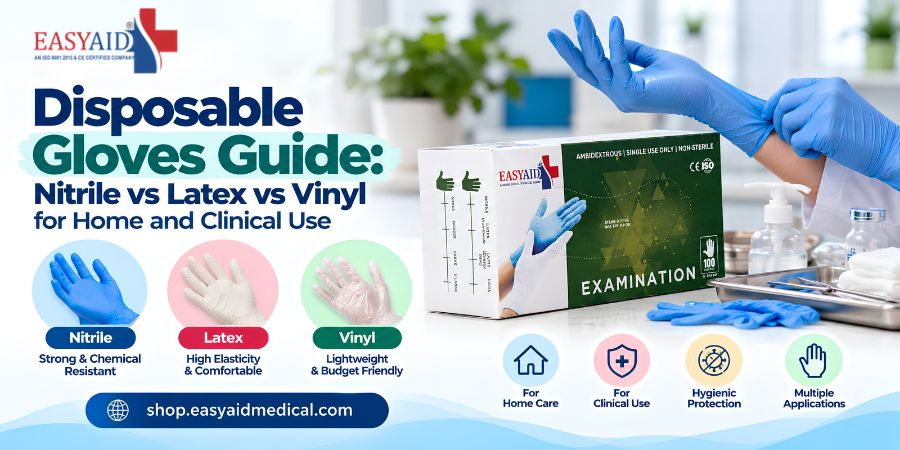
Disposable Gloves Guide: Nitrile vs Latex vs Vinyl for Home and Clinical Use
Disposable gloves are a simple part of first aid and healthcare, but choosing the right type isn’t always simple.
Walk into a medical-supply store and you’ll usually find several options: nitrile, latex and vinyl gloves. They can look similar on the shelf, yet the materials have different properties and are suited to different situations.
So, when comparing nitrile vs latex gloves, which should you choose? And are vinyl gloves suitable for home first aid or clinical use?
The answer depends on what you’re doing, how much protection and dexterity you need, whether latex sensitivity is a concern, and how the gloves fit.
This guide explains the main differences between nitrile, latex and vinyl disposable gloves and helps you choose the right option for home care, first aid, clinics and workplace use.
Important: Disposable gloves are a protective barrier, not a replacement for hand hygiene. WHO advises performing hand hygiene at the appropriate times even when gloves are worn.
Why Are Disposable Gloves Used?
Gloves are used when there is a reasonable possibility of contact with:
- Blood
- Body fluids
- Non-intact skin
- Mucous membranes
- Potentially infectious material
- Contaminated materials or surfaces in relevant work settings
In healthcare, gloves can help reduce contamination of healthcare workers’ hands and reduce the spread of microorganisms between people and environments when used correctly.
They are also useful during certain home first-aid situations, such as helping someone with an open wound or bleeding injury.
But there is an important distinction:
Gloves are not required for every everyday task.
WHO specifically notes that unnecessary glove use can waste resources and does not replace proper hand hygiene.
Nitrile vs Latex vs Vinyl: What’s the Difference?
The three common disposable glove materials can be broadly understood like this:
| Feature | Nitrile | Latex | Vinyl |
|---|---|---|---|
| Material | Synthetic rubber | Natural rubber latex | Synthetic PVC-based material |
| Latex-free | Yes | No | Yes |
| Fit | Good | Usually very close-fitting | Looser |
| Stretch | Good | Excellent | Limited |
| Tactile feel | Good | Excellent | Moderate |
| Puncture resistance | Generally strong | Good | Lower |
| Latex allergy concern | No natural latex | Yes | No natural latex |
| Common use | Healthcare, first aid, labs, cleaning | Clinical and examination use | Lower-risk, non-clinical tasks |
| Single-use | Yes | Yes | Yes |
The exact performance of any glove depends on its quality, thickness, manufacturing standards and intended use. WHO notes that glove barrier integrity can vary with glove type, quality, use conditions and other factors.
1. Nitrile Gloves
Nitrile gloves are made from synthetic rubber rather than natural rubber latex.
They have become a common choice for healthcare, first aid, laboratories and many workplace applications.
Advantages of Nitrile Gloves
Nitrile gloves generally offer:
- Good fit
- Good flexibility
- Good tactile sensitivity
- Latex-free construction
- Good resistance to punctures compared with many other disposable glove options
- Suitability for a range of healthcare and first-aid tasks
WHO materials identify nitrile as a latex-free synthetic glove material and describe its use in healthcare settings, including situations where latex allergy is a concern.
Who Should Consider Nitrile Gloves?
Nitrile can be a practical option for:
- Home first aid
- Caregivers
- Clinics
- Diagnostic centres
- Laboratories
- Dental settings
- Beauty and personal-care services
- Cleaning tasks where suitable
- General workplace first aid
If you are looking for the best gloves for home first aid, nitrile is often a practical choice when you want a latex-free disposable glove with a close fit.
That does not mean every nitrile glove is appropriate for every medical procedure. Always check the product’s intended use and specifications.
2. Latex Gloves
Latex gloves are made from natural rubber.
They have traditionally been widely used in healthcare because they offer excellent elasticity and a close fit.
Advantages of Latex Gloves
Latex gloves are known for:
- Excellent elasticity
- Close fit
- Good tactile sensitivity
- Comfortable movement
- Good dexterity for many clinical tasks
For healthcare workers who are not latex-sensitive, latex gloves can be suitable for many routine examination and patient-care situations.
WHO’s glove guidance recognises latex as one of the common materials used for disposable examination gloves.
The Main Concern: Latex Sensitivity
Natural rubber latex can cause allergic reactions in some people.
This is one reason latex-free alternatives such as nitrile and vinyl are available.
If a healthcare worker or patient has a known latex allergy or sensitivity, a latex-free glove should be considered.
For workplaces, it can be sensible to make latex-free options available where latex sensitivity is a known concern.
3. Vinyl Gloves
Vinyl gloves are made from synthetic material and are another latex-free option.
They are generally looser-fitting than nitrile or latex gloves and have less elasticity.
Where Are Vinyl Gloves Useful?
Vinyl gloves may be appropriate for lower-risk, non-clinical tasks where a close fit and high tactile sensitivity are not essential.
Depending on the product and applicable requirements, they can be used for:
- General cleaning
- Food-related tasks
- Light-duty handling
- Certain non-clinical workplace activities
- Short-duration tasks where the glove’s specifications are appropriate
WHO infection-prevention guidance identifies vinyl gloves as a synthetic, latex-free option but distinguishes their use from clinical applications.
Don’t assume that every vinyl glove is suitable for patient care.
Always check the manufacturer’s intended use, certification and product specifications before using gloves in a clinical environment.
Nitrile vs Latex Gloves: Which Is the Better Choice?
There isn’t one material that is best for everyone.
The right choice depends on the user and the task.
Choose Nitrile When:
- You want a latex-free option.
- You need a close-fitting glove.
- You’re handling minor wounds during home first aid.
- You need good dexterity.
- You’re working in a clinic or laboratory and the product is appropriate for the procedure.
- Latex sensitivity is a concern.
Consider Latex When:
- The user is not sensitive to natural rubber latex.
- Excellent elasticity and tactile feel are important.
- The glove is appropriate for the intended clinical task.
Consider Vinyl When:
- The task is lower risk.
- A looser fit is acceptable.
- High tactile sensitivity isn’t essential.
- The manufacturer specifically identifies the glove as suitable for the intended use.
Best Gloves for Home First Aid
For home first aid, the glove should mainly provide a clean barrier when you’re helping with situations involving blood, body fluids or open wounds.
A practical choice for many households is powder-free nitrile gloves because they are latex-free, fit relatively closely and are widely available.
However, the most important factors are:
- Correct size
- Intact packaging
- Appropriate intended use
- Comfortable fit
- Latex-free construction when required
- Single-use design
Keep at least a few pairs in your home first aid kit.
For example, if you’re dressing a family member’s minor cut, wearing disposable gloves can help reduce direct contact with blood or wound fluid.
After completing the task, remove and dispose of the gloves appropriately and perform hand hygiene.
WHO advises that gloves should not be reused or reprocessed and that hand hygiene should be performed after glove removal.
Gloves for Clinics and Healthcare Settings
Clinical environments have more specific requirements.
A clinic may need different glove types depending on the procedure.
Examination Gloves
Non-sterile disposable examination gloves are used for many routine healthcare activities where glove use is indicated.
Sterile Gloves
Sterile gloves are intended for procedures requiring sterile technique.
Do not assume that a standard disposable examination glove is sterile.
The product packaging should clearly identify whether gloves are sterile or non-sterile.
Procedure-Specific Selection
A clinic, hospital or diagnostic centre should select gloves based on:
- Procedure type
- Expected exposure
- Sterility requirements
- Material compatibility
- Size
- Fit
- Applicable standards
- Manufacturer specifications
WHO guidance distinguishes sterile surgical gloves from non-sterile examination gloves and recommends selecting gloves according to the care activity.
Gloves for B2B Buyers: What Should You Check?
If you’re purchasing gloves for a clinic, hospital, laboratory, pharmacy, salon or other organisation, buying purely on price can create problems.
Before placing a bulk order, check:
Material
Choose nitrile, latex or vinyl based on the intended application.
Size Range
A workplace may need multiple sizes.
Common sizes include:
- Small
- Medium
- Large
- Extra Large
The exact size availability depends on the manufacturer.
WHO guidance recommends having appropriately sized gloves available for users.
Sterile or Non-Sterile
Make sure the product matches the procedure.
Don’t assume all disposable medical gloves are sterile.
Powder-Free Option
Powder-free gloves are often preferred in healthcare environments. WHO’s glove-use material recommends non-powdered gloves as a general policy in healthcare settings.
Packaging
For clinical and B2B use, check:
- Pack size
- Individual or dispenser packaging
- Lot/batch information
- Expiry information where applicable
- Manufacturer information
- Regulatory and product specifications
Supply Consistency
For a clinic or business, running out of gloves is more than an inconvenience.
Before selecting a supplier, consider whether they can consistently provide the required size, material and pack quantity.
How to Choose the Right Glove Size
A glove that is too small can feel uncomfortable and may be more likely to tear during use.
A glove that is too large can reduce control and make handling objects more difficult.
Your gloves should:
- Fit comfortably around the fingers
- Allow normal finger movement
- Cover the wrist appropriately
- Avoid excessive looseness
- Avoid excessive stretching
When ordering for a business, don’t assume one size will work for everyone.
Keeping multiple sizes available is usually more practical.
Why Glove Fit Matters
The material alone doesn’t determine how useful a glove will be.
Fit affects comfort, movement and control.
Latex tends to provide a very close fit because of its elasticity.
Nitrile also offers a close fit while providing a latex-free option.
Vinyl generally has a looser fit and is better suited to tasks where high tactile sensitivity is less important.
WHO notes that gloves should fit appropriately and that glove choice should take the specific activity into account.
How to Put on Disposable Gloves
Before putting on gloves:
- Perform hand hygiene.
- Check the packaging.
- Make sure the glove is intact.
- Select the appropriate size.
- Put the gloves on without unnecessarily touching contaminated surfaces.
Avoid touching your face, phone, door handles or other clean surfaces unnecessarily while wearing contaminated gloves.
Gloves should be changed when they become damaged or when moving between tasks where contamination could be transferred.
WHO recommends removing gloves after patient care and performing hand hygiene after removal.
How to Remove Disposable Gloves Safely
Removing gloves incorrectly can contaminate your hands.
A simple approach is:
- Pinch the outside of one glove near the wrist.
- Peel it away from your hand without touching the skin unnecessarily.
- Hold the removed glove in your gloved hand.
- Slide an ungloved finger under the remaining glove at the wrist.
- Peel it off from the inside, containing the first glove.
- Dispose of the gloves appropriately.
- Perform hand hygiene.
The goal is to avoid touching the contaminated outer surface with bare hands.
Can Disposable Gloves Be Reused?
No. Disposable medical gloves should not be reused.
Once used, they should be removed and discarded appropriately.
WHO’s glove-use guidance specifically states that medical gloves are single-use items and that decontamination or reprocessing for reuse is not recommended.
Reusing disposable gloves can also compromise their barrier function.
For B2B buyers, this means glove stock should be planned according to actual usage rather than assuming one pair can be used repeatedly.
Gloves Do Not Replace Hand Hygiene
This point deserves repeating.
Putting on gloves does not mean your hands are automatically protected from contamination.
Gloves can have tiny defects, become contaminated during use or contaminate hands during removal.
WHO states that gloves do not modify or replace the need for hand hygiene.
So the basic sequence is:
Hand hygiene → appropriate glove use → safe glove removal → hand hygiene
This matters in both clinical environments and home first aid.
Common Disposable Glove Mistakes
Wearing Gloves for Too Long
Gloves are intended for a specific task or procedure, not for walking around indefinitely.
Using One Pair for Multiple People
In healthcare, the same pair should not be used between patients.
WHO recommends changing gloves between patients or procedures when indicated.
Choosing the Wrong Size
Poor fit can make a glove uncomfortable and reduce control.
Ignoring Latex Sensitivity
If someone has a known latex allergy or sensitivity, choose an appropriate latex-free alternative.
Assuming All Gloves Are Medical Gloves
A thin disposable glove intended for household or food use may not meet the requirements of a clinical procedure.
Check the product’s intended use.
Forgetting Hand Hygiene
Gloves are an additional barrier. They are not a replacement for cleaning your hands.
Nitrile vs Latex vs Vinyl: Quick Decision Guide
If you’re still unsure, this simple guide can help.
For Home First Aid
Nitrile: A practical latex-free option for many first-aid tasks.
Latex: Can work well when latex sensitivity is not a concern and the glove is suitable for the task.
Vinyl: More suitable for lower-risk tasks where a looser fit is acceptable.
For Clinical Use
Choose based on the procedure, exposure risk, sterility requirements, fit and product specifications.
Nitrile and latex are commonly used for clinical applications when appropriate. Vinyl may be suitable for selected lower-risk tasks, depending on the product.
For B2B Procurement
Focus on:
Material + intended use + size + sterility + quality + supply availability
rather than selecting purely by unit price.
How Many Gloves Should You Keep at Home?
There isn’t a universal number for every household.
A simple first aid kit should contain enough pairs for occasional minor injuries, with extra stock available for households that provide regular home care.
If a family member requires frequent wound dressing or personal care, glove consumption will naturally be higher.
For clinics, laboratories and businesses, stock levels should be based on actual usage and procurement requirements.
How Should Disposable Gloves Be Stored?
Keep gloves:
- In their original packaging
- In a clean, dry area
- Away from excessive heat
- Away from direct sunlight
- Away from sharp objects
- Away from chemicals that could damage the material
Don’t use gloves if the packaging is damaged or the gloves appear compromised.
For B2B storage, rotate stock so older stock is used appropriately before newer deliveries.
A Simple Disposable Glove Buying Checklist
Before buying disposable gloves, ask:
☐ What will the gloves be used for?
☐ Is latex sensitivity a concern?
☐ Do I need nitrile, latex or vinyl?
☐ Do I need sterile or non-sterile gloves?
☐ What size is required?
☐ Are powder-free gloves preferred?
☐ Is the product intended for clinical use?
☐ Is the packaging intact?
☐ Is the pack size suitable?
☐ Does the supplier offer consistent availability?
This checklist works for both individual buyers and B2B procurement teams.
FAQs
1. Which is better: nitrile or latex gloves?
Neither material is universally better. Latex generally offers excellent elasticity and tactile sensitivity, while nitrile provides a latex-free alternative with good fit and durability. The right choice depends on the task, user and any latex sensitivity.
2. Are nitrile gloves good for home first aid?
Yes, nitrile gloves can be a practical choice for many home first-aid situations involving blood, body fluids or open wounds. Choose an appropriate size and product intended for the task. Gloves should be single-use and followed by hand hygiene.
3. Are vinyl gloves suitable for medical use?
Some vinyl gloves may be suitable for selected lower-risk healthcare or non-clinical applications, depending on their specifications. They generally offer a looser fit and less tactile sensitivity than nitrile or latex. Always check the manufacturer’s intended use before using them for clinical procedures.
4. Are latex gloves safe for everyone?
No. Some people have latex sensitivity or allergy. If latex sensitivity is known or suspected, a suitable latex-free option such as nitrile may be considered. Healthcare facilities should account for latex-sensitive staff and patients when selecting gloves.
5. Can disposable gloves be washed and reused?
No. Disposable medical gloves should not be washed, disinfected or reused. WHO recommends single-use gloves be discarded after use rather than reprocessed for another procedure. Hand hygiene should be performed after removing them.
Final Thoughts
Choosing disposable gloves becomes much easier once you stop looking at them as interchangeable products.
Nitrile is a practical latex-free option for many first-aid, healthcare and workplace applications.
Latex offers excellent elasticity and tactile sensitivity but may not be suitable for people with latex sensitivity.
Vinyl can be useful for selected lower-risk tasks where a looser fit is acceptable.
For home first aid, focus on having a comfortable, appropriately sized glove that is suitable for the task. For clinics and businesses, selection should also consider sterility, intended use, quality, standards and procurement requirements.
Easyaid Medical‘s disposable glove range can help households, caregivers, clinics and businesses keep appropriate protective supplies ready.
Medical Disclaimer: This article is provided for general health and product-awareness purposes. It does not replace professional medical advice, workplace safety requirements or clinical protocols. Healthcare facilities and businesses should follow applicable regulations, infection-prevention policies and manufacturer instructions when selecting and using disposable gloves.