








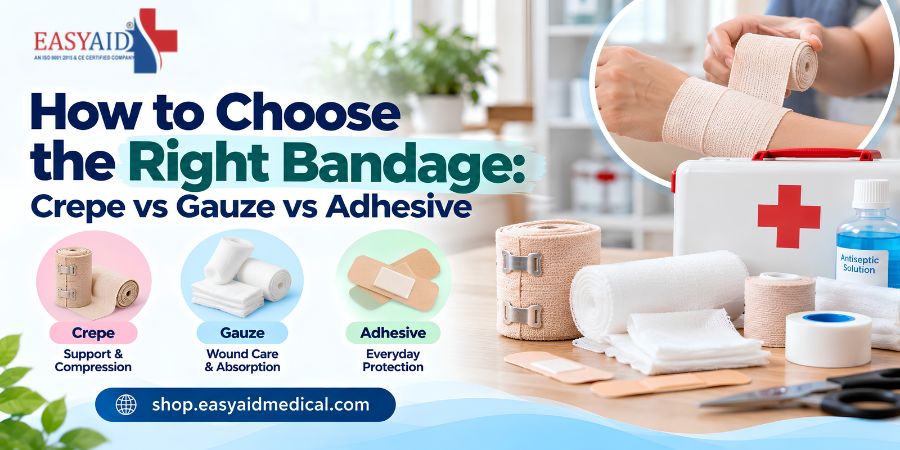
How to Choose the Right Bandage: Crepe vs Gauze vs Adhesive
When someone gets a cut, scrape, sprain or minor injury, reaching for a bandage is often the first response. But open a medical supplies box and you may find several options: adhesive bandages, sterile gauze, crepe bandages, roller bandages, and more.
So which one should you actually use?
The answer depends on the job the bandage needs to do.
An adhesive bandage can protect a small superficial cut. Gauze can cover a wound and absorb blood or wound fluid. A crepe bandage is generally used to secure dressings or provide light support and compression when appropriate.
Understanding these differences can prevent a common mistake: using one type of bandage for every injury.
This guide explains the main types of bandages, when to use each one, how to apply them safely and when an injury needs professional medical attention.
What is a bandage?
A bandage is a material used to cover, secure, support, or protect an injured area.
The word “bandage” covers several different products. They don’t all perform the same function.
Some are designed to cover a wound directly. Others are designed to hold a dressing in place or provide support around a joint.
This distinction is important because a crepe bandage should not automatically be placed directly over an open wound, while sterile gauze is specifically useful as a wound dressing.
WHO first-aid guidance recommends covering wounds with a clean dressing and using a bandage around it without wrapping too tightly.
Types of Bandages You Should Know
For most home first aid kits, three types are particularly useful:
- Adhesive bandages
- Sterile gauze dressings
- Crepe or roller bandages
Let’s look at each one.
1. Adhesive Bandage
An adhesive bandage is the familiar small dressing with an absorbent pad in the centre and adhesive material around it.
It is designed for minor wounds that don’t require a large dressing.
Best suited for:
- Small cuts
- Minor scratches
- Small abrasions
- Superficial wounds
- Minor finger injuries
- Small blisters
The main advantage is convenience.
You can clean the wound, place the absorbent centre over it and secure the bandage around the surrounding skin.
What to Look For
When buying adhesive bandages, consider:
- Different sizes
- Individually sealed packaging
- Good adhesive quality
- Skin-friendly material
- Flexible designs for fingers and joints
Keeping several sizes in your first aid kit is more practical than relying on one standard size.
2. Sterile Gauze Bandage or Gauze Dressing
Gauze is different from an adhesive bandage.
It is usually a soft, absorbent material that can be placed over a wound and secured with medical tape or another bandage.
Sterile gauze is particularly useful when the wound is larger than an adhesive bandage can cover.
Best suited for:
- Larger superficial wounds
- Cuts requiring a dressing
- Scrapes
- Wounds with minor bleeding
- Covering a wound before applying a securing bandage
Gauze can also be used as an absorbent layer when there is wound fluid.
WHO wound-care guidance recommends appropriate wound dressings and notes that dressing choice depends on the wound and the amount of exudate.
Sterile vs Non-Sterile Gauze
This distinction matters.
Sterile gauze is individually packaged and intended for use where maintaining cleanliness around a wound is important.
Non-sterile gauze may have other uses, such as cleaning or padding, depending on the product.
For an open wound, check the product label and use an appropriate sterile dressing where required.
3. Crepe Bandage
A crepe bandage is an elastic or stretchable bandage commonly used to secure dressings or provide support and light compression.
It is often used around areas such as:
- Ankles
- Wrists
- Knees
- Elbows
- Arms
- Legs
It can be useful when a dressing needs to stay in place or when light support is recommended for a minor soft-tissue injury.
A crepe bandage is not the same thing as a wound dressing.
If there is an open wound, use an appropriate dressing over the wound first. The crepe bandage can then be used to secure the dressing when appropriate.
WHO guidance advises that a bandage should not be tied too tightly because swelling can occur and circulation should not be restricted.
Crepe Bandage vs Gauze Bandage
This is one of the most common points of confusion.
A simple way to remember the difference is:
Gauze covers the wound.
Crepe bandage secures or supports.
| Feature | Gauze | Crepe Bandage |
|---|---|---|
| Main purpose | Covering a wound | Securing/supporting |
| Usually placed directly over wound | Yes, when appropriate | Generally no |
| Absorbs wound fluid | Yes | Limited/not its primary purpose |
| Elastic | Usually no | Usually stretchable |
| Used for support | Limited | Yes |
| Used with other dressings | Yes | Frequently |
| Common areas | Cuts, scrapes, wounds | Ankles, wrists, knees, elbows |
They can also be used together.
For example, if someone has a larger superficial wound on the leg, a suitable sterile gauze dressing may be placed over the wound and a crepe bandage can be used to hold the dressing in place, provided this is appropriate for the injury.
Adhesive Bandage vs Gauze
The choice between adhesive bandage and gauze usually comes down to wound size and location.
Choose an Adhesive Bandage When:
- The wound is small.
- Bleeding is minor and controlled.
- The area is easy to cover.
- You want a quick, ready-to-use dressing.
Choose Gauze When:
- The wound is larger.
- You need more coverage.
- The dressing needs to absorb fluid.
- An adhesive bandage is too small.
- You need to secure the dressing separately.
For a larger or deeper wound, don’t simply keep adding gauze and assume home treatment is enough. The wound may need professional assessment.
Crepe Bandage vs Adhesive Bandage
These products have very different roles.
An adhesive bandage is designed to cover a small wound.
A crepe bandage is generally used around a body part to secure a dressing or provide support.
For example:
Small finger cut → Adhesive bandage
Gauze dressing on an ankle → Crepe bandage may help secure it
Sprain → Crepe bandage may provide support if appropriate
The important thing is to match the product to the purpose.
How to Choose the Right Bandage
Before picking a bandage, ask four simple questions.
1. Is There an Open Wound?
If yes, you need an appropriate wound dressing.
Sterile gauze may be suitable depending on the wound.
A crepe bandage should not be treated as a substitute for a wound dressing.
2. How Large Is the Wound?
A small superficial cut may fit comfortably under an adhesive bandage.
A larger wound may require gauze or another appropriate dressing.
3. Does the Area Need Support?
If the injury involves a joint or soft tissue and support is appropriate, a crepe bandage may be useful.
However, not every painful joint should simply be wrapped.
If there is severe pain, deformity, significant swelling or inability to use the limb, seek medical assessment.
4. Does the Dressing Need to Stay in Place?
If yes, a roller or crepe bandage may be useful for securing the dressing.
Medical tape can also be used depending on the location and dressing.
How to Apply an Adhesive Bandage
For a minor cut or scrape:
Step 1: Clean Your Hands
Wash your hands before touching the wound.
Step 2: Control Any Bleeding
Apply gentle, direct pressure with clean gauze or another clean material.
Step 3: Clean the Wound
Rinse the wound with clean running water.
Step 4: Dry the Surrounding Skin
The skin around the wound should be reasonably dry so the adhesive can stay in place.
Step 5: Apply the Bandage
Place the absorbent centre over the wound.
Avoid touching the part of the dressing that will directly contact the wound.
Step 6: Monitor
Replace the bandage if it becomes wet or dirty.
Watch for increasing redness, swelling, pus, worsening pain, or other signs of infection.
WHO first-aid guidance recommends cleaning wounds with clean water and covering them with a clean dressing that does not stick to the wound.
How to Use Gauze Safely
Gauze should be selected according to the wound and its intended purpose.
For a minor wound:
- Wash your hands.
- Put on disposable gloves when appropriate.
- Control bleeding with direct pressure.
- Clean the wound.
- Place an appropriate sterile gauze dressing over it.
- Secure the gauze using medical tape or a suitable bandage.
- Change the dressing when it becomes wet or dirty.
If gauze sticks to the wound, don’t pull it off aggressively.
WHO wound-care guidance notes that a dressing that sticks can be moistened appropriately to help release it without damaging the wound.
How to Apply a Crepe Bandage
Crepe bandages need a little more care because wrapping them too tightly can cause problems.
Start Below the Injured Area
Depending on the body part and intended use, begin wrapping in a way that provides even coverage.
Keep the Pressure Even
Avoid creating extremely tight sections.
Don’t Cover Fingers or Toes Unnecessarily
If the injury involves a limb, keeping the fingers or toes visible can make it easier to notice changes in colour or circulation.
Check After Application
Watch for:
- Numbness
- Tingling
- Increasing pain
- Cold fingers or toes
- Pale or blue skin
- Increasing swelling
If these occur, loosen the bandage and seek medical advice when appropriate.
WHO specifically advises that a bandage should not be wrapped too tightly.
Common Bandaging Mistakes
Even simple first aid can go wrong when the wrong product is used.
Using a Crepe Bandage Directly on an Open Wound
A crepe bandage is generally meant to secure or support, not replace the primary wound dressing.
Use an appropriate dressing underneath when needed.
Wrapping Too Tightly
A tight bandage can interfere with circulation.
Comfortable support is the goal.
Reusing Dirty Dressings
A dressing that has become wet or dirty should be changed.
Clean wound-care materials matter. WHO guidance recommends clean dressings and warns against using dirty or wet bandages.
Covering a Wound Without Cleaning It
For minor wounds, cleaning is an important first step.
Don’t simply put a bandage over dirt and debris.
Using the Wrong Size
A tiny adhesive bandage won’t properly cover a larger wound.
Likewise, using an unnecessarily large dressing for a tiny cut can be inconvenient.
Choose a size that covers the wound appropriately.
When Should You Not Treat an Injury With a Simple Bandage?
A bandage is not a solution for every injury.
Seek medical attention if:
- Bleeding is heavy or does not stop with direct pressure.
- The wound is deep or gaping.
- There is significant tissue damage.
- A foreign object is deeply embedded.
- There is a suspected fracture.
- The injured area looks deformed.
- There is severe or worsening pain.
- There are signs of infection.
- The injury resulted from a serious accident.
- An animal or human bite has occurred.
WHO first-aid guidance recommends escalation for wounds that are large, deep, associated with deformity or have bleeding that cannot be controlled.
For major injuries, the priority is getting professional medical help rather than trying different bandages at home.
Which Bandages Should You Keep in a Home First Aid Kit?
A practical home kit doesn’t need dozens of varieties.
Keeping a few basic types covers many everyday situations.
Recommended Basics
Adhesive Bandages
For small cuts, scratches and superficial wounds.
Sterile Gauze
For covering wounds that need more coverage than an adhesive bandage provides.
Crepe Bandage
For securing dressings and providing light support when appropriate.
Medical Tape
For securing gauze and other dressings.
Disposable Gloves
For protecting the caregiver when dealing with blood or body fluids.
A combination of these products gives you more flexibility than buying a large quantity of one type.
Choosing the Right Bandage Size
Size matters more than many people realise.
For adhesive bandages, keep small, medium and larger sizes.
For gauze, different dimensions can help with different wound sizes.
For crepe bandages, choose the width based on the body area and intended use.
A narrow bandage may be useful around a wrist or smaller joint, while a wider option may provide better coverage around a larger area.
Always check the manufacturer’s instructions and product specifications.
How Often Should a Bandage Be Changed?
There is no universal schedule for every wound or dressing.
A bandage should generally be changed when it becomes wet, dirty, loose or otherwise unsuitable.
The type of wound and amount of wound fluid also affect how frequently a dressing needs to be changed.
WHO guidance notes that dressing changes depend on factors such as wound exudate and that wet or dirty dressings should be replaced.
If a wound requires ongoing dressing changes, follow the instructions provided by your healthcare professional.
Quick Decision Guide
Still confused?
Use this simple guide.
Small cut or scrape?
→ Adhesive bandage
Larger superficial wound?
→ Sterile gauze + suitable securing method
Need to hold gauze in place?
→ Crepe/roller bandage or medical tape, depending on the situation
Minor joint injury where support is appropriate?
→ Crepe bandage may be suitable
Heavy bleeding?
→ Apply direct pressure and seek urgent medical care if bleeding is not controlled
Deep or gaping wound?
→ Medical assessment
FAQs
1. What are the main types of bandages?
The common types include adhesive bandages, sterile gauze dressings and crepe or roller bandages. Adhesive bandages are useful for small wounds, gauze is mainly used to cover and absorb around wounds, and crepe bandages are commonly used to secure dressings or provide light support.
2. What is the difference between a crepe bandage and gauze bandage?
Gauze is primarily used as a wound dressing and can absorb blood or wound fluid. A crepe bandage is generally used to secure a dressing or provide support and light compression. They can be used together when appropriate.
3. Can I use a crepe bandage directly on a wound?
A crepe bandage is generally not a substitute for a primary wound dressing. If there is an open wound, use an appropriate sterile dressing such as gauze when suitable, and use the crepe bandage to secure it if needed.
4. Is an adhesive bandage enough for a deep cut?
No. A deep, gaping or heavily bleeding wound should be assessed by a healthcare professional. An adhesive bandage is intended for minor superficial wounds and should not be used to manage a serious injury at home.
5. How tight should a crepe bandage be?
It should provide appropriate support without restricting circulation. If you experience numbness, tingling, increasing pain, unusual swelling or colour changes in the fingers or toes, loosen the bandage and seek medical advice if needed.
Final Thoughts
Choosing a bandage becomes much easier once you understand what each type is designed to do.
Adhesive bandages are convenient for small cuts and scrapes.
Sterile gauze is useful for covering larger wounds and absorbing blood or wound fluid.
Crepe bandages are generally used to secure dressings or provide support and light compression when appropriate.
You don’t need every possible bandage in your home. A practical combination of these basics can cover many everyday first-aid situations.
If you’re building or refreshing your home first aid kit, explore Easyaid Medical’s range of Bandages and Crepe Bandages to choose the right product for your needs.
Medical Disclaimer: This article is intended for general health awareness and educational purposes. It does not replace professional medical advice, diagnosis or treatment. For severe bleeding, deep wounds, suspected fractures, major injuries or other emergencies, seek immediate medical assistance.